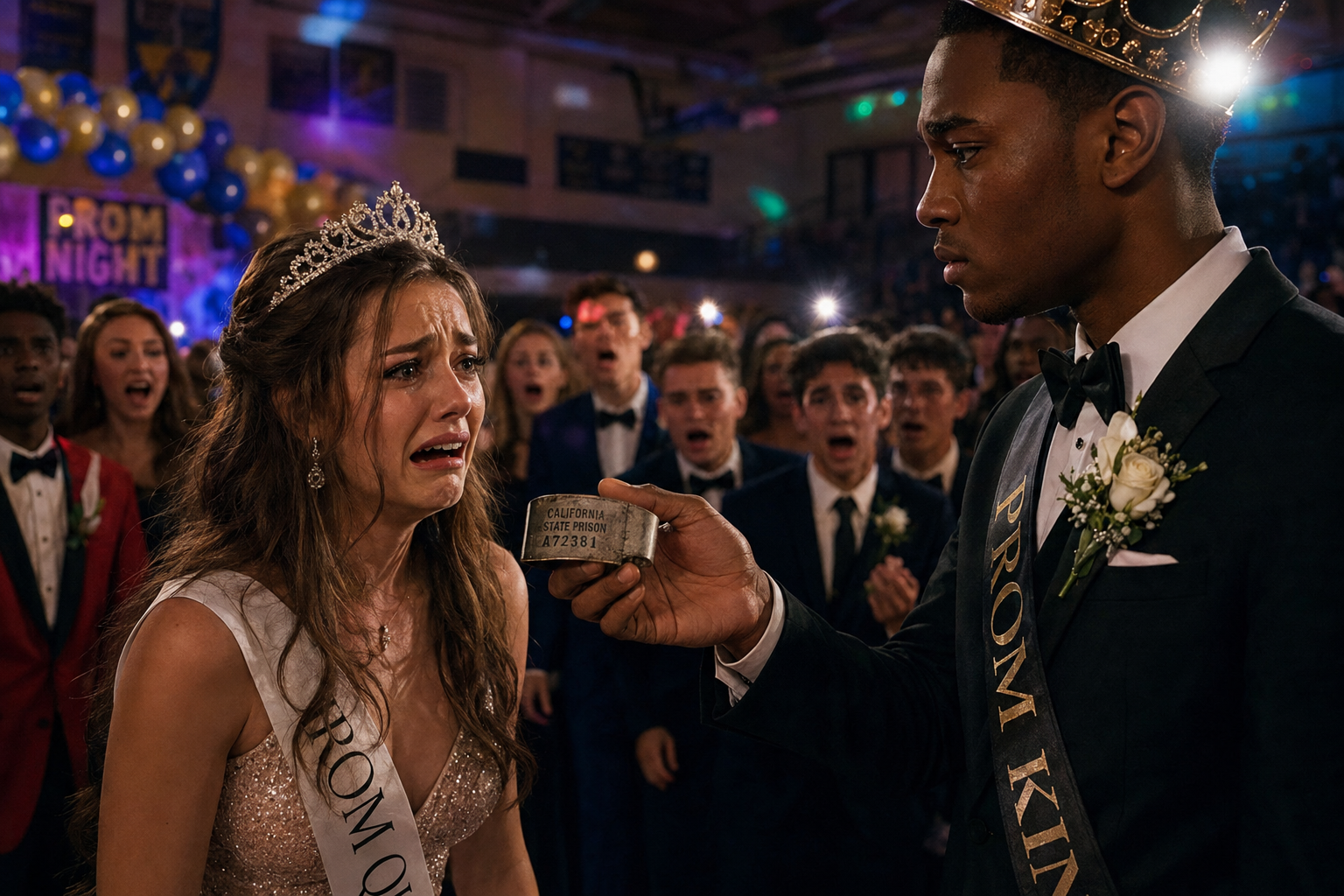
Nobody expected the prom king to make a girl cry.
I need to say that first, because everything that followed has been described in a hundred different ways by people who were there and people who weren’t, and most of those descriptions start in the wrong place.
They start with the slap. They start with the bracelet. They start with the part that looks dramatic from the outside, the part that translates well into a thirty-second video clip.
But the real story starts years earlier, in a story Hailey had already told herself so many times it had become the kind of truth that stops feeling like a choice and starts feeling like fact.
My name is Marcus Webb. I am eighteen years old. And I need to tell you what actually happened that night, because I was the one standing on that stage, and I am the only one who knows all of it.
Hailey and I went to the same high school for four years without ever being close. We ran in different circles — she was cheerleading and student council, I was track and AP classes and the kind of deliberate invisibility that comes from being one of twelve Black students in a school of six hundred. We were friendly in the way that people who share spaces for long enough become friendly without really knowing each other.
I knew two things about her before any of this happened.
One: her father had died when she was very young. She never talked about it directly, but it was the kind of thing that moved through a school quietly over the years — a fact everyone absorbed without anyone making a point of mentioning it.
Two: she was kind in a specific, unpracticed way that I had always noticed and never said anything about. The kind of kind that doesn’t perform. She remembered when people were having a hard week and asked about it the following Monday. She did not make a show of caring. She just cared.
Those two things matter for what came later.
In October of my senior year, I started doing mandatory community service hours at a transitional facility for recently released individuals about forty minutes from our town. My mentor had arranged it. Twice a week, Tuesday and Thursday afternoons, I helped with a literacy and employment readiness program — basically sitting with people and helping them fill out job applications and practice for interviews.
Most of the men in that program were quiet. They did not particularly want to be there. They came because it was required, or because they had nothing else to do in those afternoon hours, or because the alternative was sitting alone in a small room thinking about everything they had missed.
One of them talked to me.
His name was Daniel.
He was fifty-one years old, thin, with the specific careful posture of someone who had spent a long time learning to take up as little space as possible. He was not unfriendly — he was cautious in the way that people become cautious when they have learned that openness costs something.
We started talking about ordinary things. The job application forms. The difference between a resume and a cover letter. The right way to answer the question about gaps in employment history when the gap is a decade and the reason is something you cannot say plainly on paper.
He was smart. Genuinely, uncomplicatedly smart — the kind that shows up in how someone thinks through a problem rather than in credentials or vocabulary. He had been an electrician before. He knew things about how buildings worked, about systems and wiring and the logic of structures, and when he talked about that work his posture changed slightly.
Over several weeks, he asked me small questions about my life. Where I went to school. What I wanted to study. What the town was like now compared to what he remembered of it.
It was that last question that caught me.
“What do you remember of it?” I asked.
He was quiet for a moment. “I grew up about six miles from where your school is,” he said. “A long time ago.”
He said it in a way that closed the subject, so I didn’t push.
About a month into my time there, on a Thursday afternoon when the room was quieter than usual, Daniel asked if I knew a girl named Hailey.
I was not expecting it.
“I go to school with someone named Hailey,” I said carefully.
He nodded slowly. He looked at the table.
“She would be about seventeen now,” he said. “Maybe eighteen.”
I watched his face.
“Is she all right?” he asked.
I told him honestly that I didn’t know her well enough to say. That she seemed okay from what I could see. That she was well-liked.
He nodded again. Said thank you. Did not explain.
But then the following Tuesday he was waiting when I arrived, which was unusual, and he asked if we could talk before the group session started.
We sat at a corner table.
He told me that Hailey was his daughter.
He told me that he had left when she was very young — not the clean, voluntary leaving of someone who chose to go, but the more complicated leaving of someone who was taken away by a consequence of his own making. He did not give me the details and I did not ask for them. He said only that by the time he understood the full weight of what he had cost her, too much time had already passed for him to know how to go back.
Her mother had told Hailey he was dead.
He said it plainly, without bitterness. He understood why. He said he probably would have done the same thing, in her mother’s position, trying to explain an absence to a seven-year-old girl who needed an answer that made sense.
He said he had spent years trying to find a way to reach Hailey that would not destroy the story her mother had built to protect her. He said he had not found one.
Then he said something that I have thought about every day since.
He said: “She deserves to know that I never stopped thinking about her. Even if she never wants to see me. Even if she would rather I stayed a story that made sense. She deserves to know that the version of me that left her was not the only version that existed.”
He asked if I would tell her.
Not everything. Not all at once. Just enough.
He gave me something to prove it was real — a worn identification bracelet from the facility, his name and date printed on it, the kind of thing that could not be faked. He said: give her this. Let her decide what she does with it.
I held that bracelet for three weeks.
I thought about whether to do it at all. I thought about whether it was my place. I thought about what it would mean for Hailey, who had built her whole understanding of her own history on a particular story, to have that story come apart.
I thought about what she had said once, in a group project junior year, when we were discussing grief and loss in the context of a book we were reading.
She had said, very quietly, that the worst part of losing someone too young was not knowing what they might have become. Not knowing if you would have liked each other as adults.
I thought about that sentence a lot during those three weeks.
The night of prom, I did not plan what happened.
I had planned to find a quiet moment — before or after, somewhere private. I had not planned the stage. I had not planned the crowd. When they called our names and Hailey and I were standing at the center of that gym with crowns on our heads and five hundred people watching, I made a decision I had not fully thought through.
I leaned in close and I whispered what her father had asked me to say.
I told her he was alive.
I used the exact words he had given me — the specific sentence he said he had whispered to her on the last night he was home, when she was seven years old and he was putting her to bed, a private thing between a father and a very small daughter that he said she would recognize.
She recognized it.
I understand why she reacted the way she did. I want to say that clearly. If someone had whispered something into my ear in a room full of people — something that shattered a fifteen-year-old certainty about my own life — I cannot promise I would have handled it with more composure.
The slap was fair.
The screaming after — the questions, the shaking, the moment when her voice broke in front of five hundred people asking how I could possibly know what her dead father had said to her — that was also fair.
What was not fair was that I had chosen the wrong moment, and I have had to sit with that.
I told her everything in the gymnasium, in front of everyone, because she asked and I could not find a reason to withhold it. I told her about the facility. About Daniel. About the Tuesday afternoons and the job applications and the conversation that had started with a cover letter and ended with a secret too large for one man to carry alone any longer.
Then I gave her the bracelet.
She went very still.
The gymnasium went very still with her.
She held the bracelet for a long time, turning it over in her hands, reading his name. Her breathing was audible in the silence. Someone had cut the music. Nobody moved.
Then she sat down on the stage steps, right there, in her prom dress with her crown still on her head, and she cried in the way that people cry when they are releasing something they have been holding for a very long time without knowing they were holding it.
A teacher came to sit with her. Her best friend pushed through the crowd and sat on the other side.
I stepped back.
I did not know what she would do. I still do not know what she has decided, or whether she has reached out to him, or whether she has chosen to leave the story the way it was and keep him as the absence that was easier to live with.
That is her choice. It was always her choice. I was only ever the person who carried the message.
What I know is that Daniel sat in that program for months carrying a sentence his daughter had never heard, and he trusted a stranger with it because he had run out of other options.
What I know is that Hailey had spent fifteen years asking, quietly and not, the unanswerable question of who her father might have become.
What I know is that some truths wait a very long time for the right door to open, and sometimes the door is a prom night in a gymnasium in a small town, and the person holding it open is someone who had no business being involved at all.
I don’t know if I did the right thing.
I think I did what the situation asked of me, which is a different calculation.
I think Daniel deserved to have someone try.
And I think Hailey, whatever she decides, deserved to know that the ending she had memorized was not the only one available to her.
So choose a side: Marcus did the right thing — Daniel had been searching for years and Hailey deserved the truth, even delivered imperfectly. Or Marcus should have stayed out of it — this was not his story to tell, and no moment in a crowded gymnasium is the right time to dismantle someone’s entire understanding of their own life.
Share this if you believe that some secrets, no matter how long they’ve been kept, belong to the person they were kept from — and that a stranger with nothing to gain is sometimes the only one willing to tell the truth.
You might also enjoy: More Inspiring People Stories on KindlyTold
Get Heartwarming Stories in Your Inbox
Join thousands of readers getting uplifting stories every week.