My father’s hands were never clean.
I don’t mean that in a bad way. I mean it literally. No matter how many times he scrubbed them, no matter what brand of soap my mother kept buying, there was always a thin line of grease along his knuckles, a permanent darkness under his nails that told you exactly who he was and what he loved.
He loved cars. He loved fixing things. And more than anything, he loved the little auto workshop on Deerfield Road that he had built from nothing when he was twenty-three years old.
I was four when he opened it. I don’t remember the opening day itself, but I’ve seen the photos so many times they feel like real memories. My dad standing in front of the bay door with a set of keys dangling from one finger, grinning so wide it looked like it must have hurt. My grandmother in the background with her hand on her heart. A few of his friends from the neighborhood holding paper cups of coffee in the cold. And me, apparently, though in every photo I’m either asleep against someone’s shoulder or pointing at something off-camera, completely unaware that the thing my father was celebrating would become the center of my entire childhood.
I grew up in that workshop.
Not literally, but close enough. Every day after school, if my mom was working a late shift, I’d walk the six blocks from the bus stop to Deerfield and let myself in through the side door that my dad always left unlocked for me. He’d look up from whatever engine he was buried in — and he was always buried in something — wipe his hands on the grey rag he kept tucked into his belt, and give me that look. The one that said he was glad I was there without him ever having to say it out loud.
He taught me things in that workshop. Not just about cars, though I can change a tire and check an oil filter faster than most adults I know. He taught me about patience. About how most things that are broken can be fixed if you’re willing to take the time to understand why they broke in the first place. About how you don’t have to be the loudest person in the room to be the most important one in it.
He was the quietest man I ever knew. Soft-spoken, methodical, never in a rush even when everything was on fire around him. People always said they trusted him the moment they met him, and I think it was because of that quality — that steadiness. You don’t trust someone who talks too much. You trust someone who shows up, does the work, and doesn’t make a show of it.
The workshop had three full-time employees by the time I was in high school. One of them, a man named Rogelio, had been with my dad since the very beginning. He was fifteen years older than my father, with the kind of quiet that went even deeper than my dad’s — a man who had clearly decided long ago that words were mostly unnecessary and that showing up was the only thing that mattered. He had hands rougher than anyone I’ve ever seen, and a face that looked like it had already witnessed every version of every situation and found none of them particularly surprising.
He and my dad had a kind of friendship I used to try to describe to people and could never quite get right. They’d work side by side for hours barely speaking, and somehow you could feel, just by being in that room, how much they meant to each other. It was the kind of friendship built on something more solid than conversation.
My parents separated when I was thirteen.
I’m not going to go into all of it. It was hard the way those things are always hard. My dad didn’t fight the separation. That was his way — not passivity exactly, more like a deep understanding that some things were already decided and that raising his voice wouldn’t change anything. He moved into a small apartment twenty minutes away and we had dinner together three times a week without fail, and he came to every single school event, every concert, every volleyball game, every presentation I ever gave. He always sat in the front row so I could find him the moment I walked in.
He never missed one.
Not one.
My mom remarried two years after the separation. A man named Dennis. Dennis sold commercial real estate. He wore pressed shirts on weekends and shook hands too firmly and always seemed vaguely uncomfortable around people who worked with their hands — that particular discomfort of a man who has decided that physical work is a lesser kind of work. He wasn’t violent. He wasn’t cruel in any obvious way.
But he made comments. Small, consistent ones, about the workshop. About its location. About its ceiling. About what a man with real business sense might have done differently with those years and that energy. I was sixteen. I didn’t always have the exact words for what those comments made me feel. But I understood what he was saying and I understood what he wasn’t saying — that he thought my father had wasted his life building something small — and both things made me feel a cold, focused fury I didn’t know what to do with.
My dad got sick when I was sixteen.
Pancreatic cancer doesn’t give you much warning. By the time they found it, he was already Stage III. He went through everything the doctors suggested. He kept working at the workshop for as long as he physically could, showing up on days when I could see clearly that being upright was costing him something enormous. I think the workshop was the only way he knew how to tell himself he was still okay. As long as he could be there, moving between the bays, talking to Rogelio, he wasn’t losing yet.
He died on a Thursday in February. Eleven days after his fifty-first birthday.
I was with him. My mom came too, even though they’d been divorced for three years. Rogelio was in the waiting room the entire time. He didn’t come into the room. That wasn’t his way. But he was there, and I knew he was there, and knowing that made it slightly more possible to breathe.
The reception was held at my aunt’s house three nights later.
It was one of those nights that has too many people in it. The house was full of relatives I hadn’t seen in years, people from the workshop, neighbors, people from my dad’s past who kept finding me and telling me things about him I’d never known. I had to keep rearranging my face into something that looked like gratitude even though what I felt was a desperate need for everyone to leave so I could be somewhere quiet. There were flowers everywhere. A buffet table nobody was touching. The ambient, polite, enormous grief of a room full of people carrying something they don’t know how to put down.
Dennis was drinking.
I noticed early. He had a glass of something amber-colored and he kept refreshing it and he was getting louder as the night went on — not sloppy loud, but expansive loud. The volume of a man who feels his opinions becoming more important with every drink.
I was across the room when I heard him laugh.
It wasn’t a quiet laugh. It was the full, easy, carrying laugh of a man performing confidence for an audience. And then came the words, delivered to some colleague of his I’d never met, with the casual authority of a man closing a deal:
“That little shop on Deerfield? Already have a buyer lined up. Location’s decent, actually. Could’ve been a real goldmine if anyone had thought to develop it properly back when they had the chance.”
The room didn’t stop. Other conversations kept going. The low music kept playing.
I was already moving.
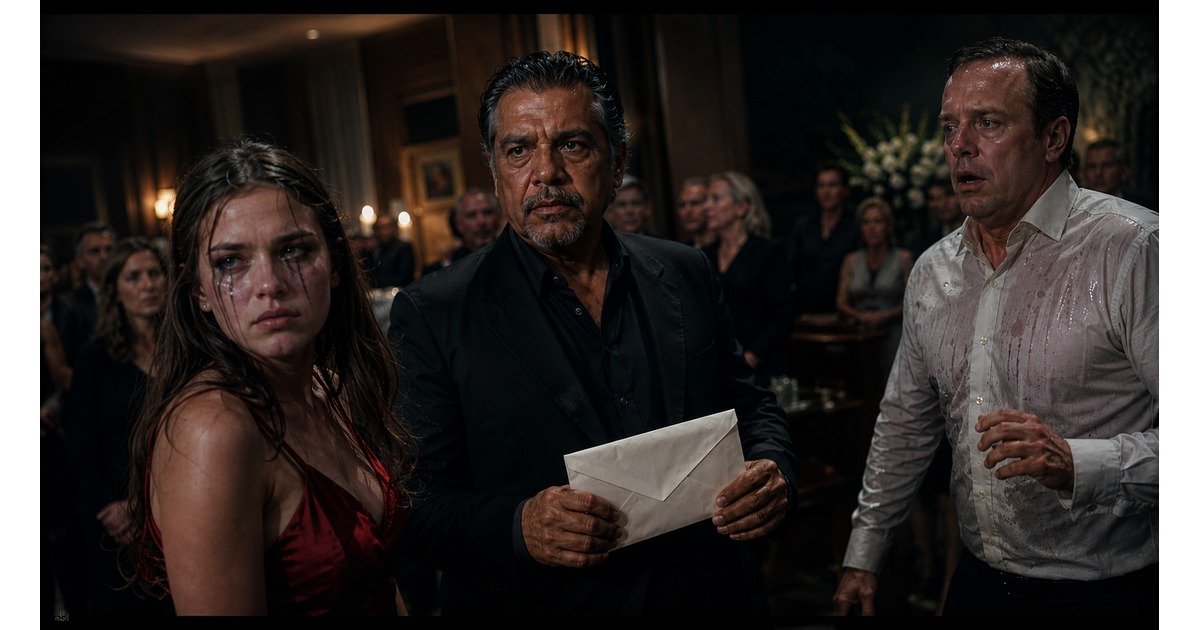
I don’t remember deciding to walk over to him. I don’t remember deciding to do what I did next. What I remember is holding a glass of soda water, and then being close enough to see the ice in his glass, and then the soda water was in his face.
All of it. The whole glass.
The room stopped.
He grabbed my arm. Hard. His face moved from shock to fury in the space of half a second. He started to say something and I was saying — too loudly, into the sudden silence of a room full of people:
“My father built that workshop for us. For our family. You do not get to sell it. It is not yours.”
People were staring. My aunt had both hands over her mouth. My mom was across the room and I couldn’t read her expression from that distance.
And then the side door opened.
Rogelio walked in.
He was wearing a dark suit I had never seen before, clearly bought for the occasion and clearly not something he was comfortable in. He was holding an envelope — sealed, thick, with my father’s handwriting on the front. He scanned the room. He saw Dennis’s hand on my arm.
He said, quietly enough that people had to lean in to hear:
“Let her go.”
Something in the way he said it — the complete absence of anything to prove — made Dennis let go.
The room was so still I could hear the candles.
Rogelio looked at me. “Your father gave me this three months ago,” he said. “He told me to wait until tonight. I don’t know everything in it. But I know the part he told me.”
He held out the envelope.
Inside was a letter in my father’s handwriting — four pages, which I’m going to keep between us — and a set of legal documents.
My father had put the workshop into a trust. The trust had one beneficiary. Me. When I turn eighteen, the shop on Deerfield Road will be entirely and legally mine. Not my mother’s. Not Dennis’s. Mine. He had done it quietly, three months before he died, without telling anyone except Rogelio and his lawyer.
Dennis had been talking to a buyer about a property he had never owned and never would.
I watched my stepfather’s face move through confusion, then something calculating, then a slow and total deflation — like a version of himself he’d been very carefully performing had just been walked quietly off the stage.
He backed away from me.
He didn’t say another word that night.
I read my father’s letter alone, later, sitting in my aunt’s car in the driveway with the interior light on because I needed somewhere quiet that wasn’t full of people looking at me.
He wrote it when he still had clarity but already knew how things were going. He wrote that the workshop was never just a business. That it was proof — physical, real, grease-stained proof — that a man with steady hands and honest work can build something that lasts. That he’d always planned for me to have it. Whether I kept it running, rented it out, or sold it myself someday on my own terms, those decisions were mine to make. Not anyone else’s.
He wrote that Rogelio would help me navigate everything, if I wanted. That he had offered Rogelio a full partnership years ago and Rogelio had turned it down because he said he didn’t want the paperwork. But that he had shown up every single day for twenty-two years anyway, which my dad said meant more than any contract ever could.
He wrote that he loved me.
I already knew that. But reading it in his handwriting, in the present tense, written when he knew exactly what was coming — I’ll be honest with you. I couldn’t breathe for a little while. I just sat in that car in the dark with the letter in my hands and let it happen.
The workshop is still on Deerfield Road.
I’m seventeen. I can’t take ownership until next year. But Rogelio is there every single day, same as always. Two of the original employees stayed on. My aunt is helping with the legal side. The bay door still has the same slight squeak it’s always had, and the side door is still left unlocked during business hours, just like when I was a kid walking six blocks from the bus stop after school.
Dennis and my mom are still together. I’m working on knowing what to do with that. I don’t think I’m there yet.
What I keep coming back to is this: my father was the quietest man I ever knew. He didn’t argue. He didn’t confront anyone. He didn’t give speeches or make threats or let on, at any point in those final months, what he had put into motion.
He just quietly made sure — while he still had the time and the clarity to do it — that what he had spent his life building could not be taken away from us.
That’s who he was. If you ever met him, you already knew that’s exactly the kind of thing he would do.
Some people believe a father has the right to leave what he built to whoever he chooses. Others will say family is more complicated than that. Which side are you on?
Share this if you believe the quiet ones always find a way. And share it if you think a daughter standing up for her father — even at the worst possible moment — took real courage.
Get Heartwarming Stories in Your Inbox
Join thousands of readers getting uplifting stories every week.