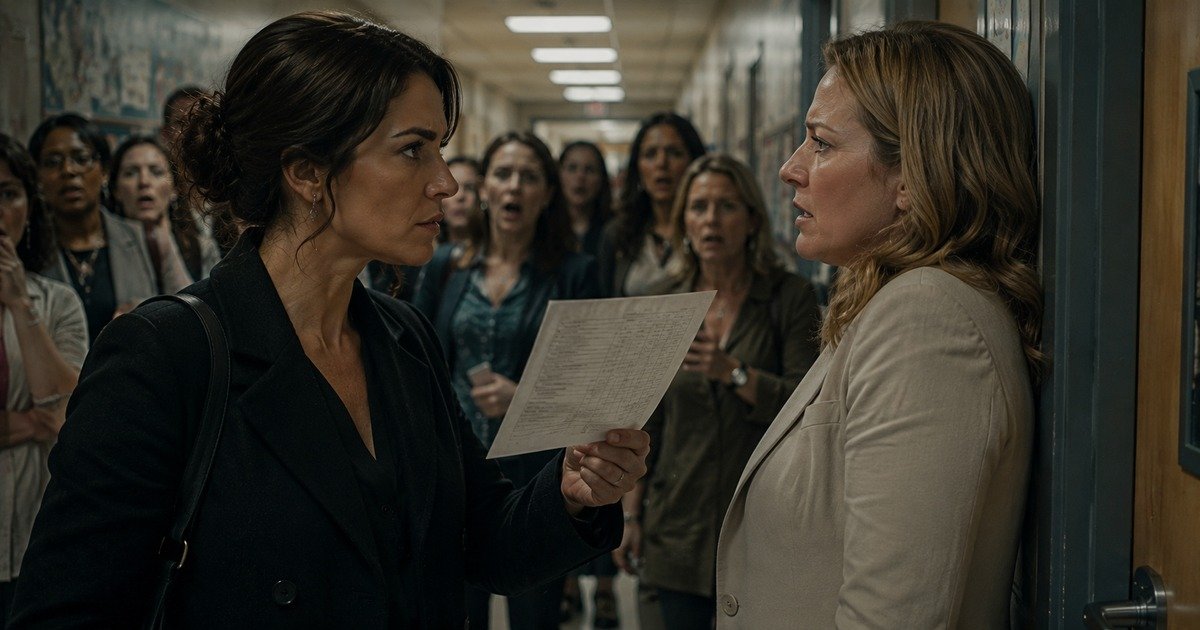
I still have the report card. It is in the top drawer of my dresser in a frame I bought from a discount store for three dollars and forty-nine cents, and I have looked at it on significant days – his high school graduation, his college move-in, last month when he called me – because I made myself a promise that I would keep looking at it until it stopped meaning what it once meant to me. I’m not entirely there yet, but I’m closer than I used to be.
Marcus was ten years old when Mr. Hensley wrote those words in the comment section of his fifth grade report card. Not college material. Encourage realistic expectations at home. The handwriting was neat and even, the kind of handwriting that belongs to someone who considers themselves careful and precise. Marcus had received a C in reading, a C-minus in math, and an unsatisfactory in classroom participation. He had also, that same semester, been diagnosed with ADHD following an evaluation that had taken me fourteen months and three referrals to finally complete. This context does not appear to have factored into Mr. Hensley’s assessment.
I remember sitting at the kitchen table that evening after Marcus had gone to bed and reading the comment four times. Each time I finished reading it I put the card face-down on the table and then I picked it up and read it again. I’m not sure why I did this. I think I was giving the words repeated chances to mean something less than they appeared to mean, the way you reread a medical report hoping the second reading will produce a different result.
Marcus was my middle child and my quietest one. His older sister Maya had been reading chapter books by the time she finished second grade and had a quality of self-organized confidence that seemed to have arrived with her at birth rather than being developed over time. His younger brother DeShawn was two at the time of the report card and was primarily interested in dump trucks and asking why about everything. Marcus existed between these two in a particular way – thoughtful, observant, slow to answer questions not because he didn’t have thoughts but because he wanted to be sure of what he was going to say before he said it. In a classroom that rewarded fast verbal response and steady eye contact, this made him invisible at best and a problem at worst.
He had told me earlier that year, in a matter-of-fact way that had broken my heart quietly, that he didn’t think he was smart. He said this the way he said most things – without drama, as an observed fact about himself that he had reached through evidence. I had told him he was wrong. He had nodded politely in the way of a child who hears something reassuring from a parent and understands it to be love rather than information. I had not had the tools to prove it to him yet.
After the report card, I got the tools.
I found a tutor through our church – a retired teacher named Mrs. Abramowitz who had spent thirty years in elementary education and who sat across from Marcus at our kitchen table for the first time on a Saturday morning in January and spent forty minutes asking him questions and listening to his answers and then looked at me and said he was one of the most careful thinkers she had worked with in years. She said he processed information deeply rather than quickly, which was a strength that school systems were structurally bad at recognizing. She said it was going to take work and patience and that he was absolutely going to be fine. I drove home from dropping her off that evening and cried in the car for ten minutes, not from sadness but from the specific relief of having someone competent tell you that what you believed about your child is true.
We worked. That is the plain version of the next several years. Marcus worked. Mrs. Abramowitz worked with him twice a week for three years until we could no longer afford the sessions, at which point she continued coming once a week and refused to accept payment, which I argued with her about until she told me to stop wasting both our time. I worked two jobs for a stretch of two years – my regular position as an administrative coordinator and a weekend job at a catering company – specifically to cover the cost of the learning specialist his school district eventually agreed to provide after I filed a formal accommodation request that took me six months of documentation and two meetings with district officials to obtain. His father worked extra shifts when he could. We were not wealthy people. We were people who had been told that our son had a ceiling, and we had decided to spend whatever we had on ladders.
Marcus was not a dramatic success story in the way of movies about underestimated children. He didn’t suddenly become a straight-A student or win a state competition that made everyone who doubted him look foolish in a single afternoon. Real life is slower and quieter than that, and I think that’s appropriate. What happened instead was that he found his pace. He found that biology made sense to him in a way that required a different kind of thinking – systems thinking, patience for complexity – and that this was a strength rather than an obstacle. He found a high school teacher named Mr. Okafor who assigned a research project on the human circulatory system and told Marcus afterward, in front of the class, that his paper showed a quality of thinking that was genuinely unusual. I know this because Marcus called me after school that day, which was not something he did often, and told me about it with a restraint in his voice that I recognized as the careful management of a feeling too large to express directly.
He applied to nine colleges. He was accepted by four. He chose the one with the strongest pre-med program he’d been accepted to, took out loans, worked part-time in a campus research lab, and graduated in four years with a biology degree and a GPA that would have surprised Mr. Hensley, though I did not make it my business to ensure Mr. Hensley was informed.
The call from Johns Hopkins came on a Tuesday. I was in the grocery store. I answered and heard his voice and the particular quality of it told me before he said a single word. He said: Mom. They said yes. I put down the basket I was carrying and stood in the cereal aisle and told him I was so proud of him I couldn’t find a word for it, and he said he knew, and neither of us said anything else for a moment because we didn’t need to.
I have thought many times over the years about Mr. Hensley and what precisely it cost him to write what he wrote. I don’t think he was a cruel man in any deliberate sense. I think he was a tired teacher with thirty students and a system that measured a narrow range of attributes and called it potential. I think he looked at a quiet, slow-processing ten-year-old boy and made a calculation based on inadequate data and insufficient imagination, and I think he has probably made similar calculations many times before and since without knowing the weight of what he set in motion.
What he set in motion, in our case, was not despair – though it visited, particularly during the years when Marcus struggled and doubt accumulated and I lay awake calculating what I could cut from the budget to pay for the next round of tutoring. What he set in motion was something I can only describe as a kind of clarification. He made the stakes plain. He wrote his assessment in neat, careful handwriting and signed his name to it, and I took it home and read it four times at a kitchen table and then got up the next morning and started.
Marcus calls every Sunday. He is tired most of the time and talks about his rotations with the exhausted precision of someone who is simultaneously overwhelmed and doing exactly what they were built to do. Last Sunday he mentioned that one of his professors told him he asked better questions than anyone else in the cohort. He said this in passing, as a detail, not as a point of pride. That quality – the careful observation, the willingness to think before speaking, the depth before speed – has been there since he was ten years old and sitting quietly at a desk in a fifth grade classroom while a teacher decided it wasn’t worth very much.
I will take the framed report card down eventually. Probably after he finishes. It was never about him seeing it – he knows it exists and we have spoken of it exactly once, when he was seventeen, and he looked at it for a moment and then set it down and said hm in the quiet way he has of processing something fully before he lets it go. It was about me remembering what I was working against, and why. Now that he’s getting where he was always going, I find I need to look at it less. The thing it represented has been answered in the only language that was ever worth using – not argument, not confrontation, not a letter to the district. Just thirteen years of showing up, and a Tuesday phone call from Baltimore, and my son’s voice saying they said yes.
You might also enjoy: More Inspiring People Stories on KindlyTold
Get Heartwarming Stories in Your Inbox
Join thousands of readers getting uplifting stories every week.



1 thought on “My Son’s Fifth Grade Teacher Wrote on His Report Card That He Was ‘Not College Material’ and Should Consider ‘Realistic Expectations’ – So I Took the Card Home, Read It Twice, Framed It, and Spent the Next Thirteen Years Making Sure He Had Every Single Resource That Teacher Decided He Didn’t Deserve, and Last Month He Called Me From Johns Hopkins to Tell Me He’d Been Accepted to Medical School”
Comments are closed.