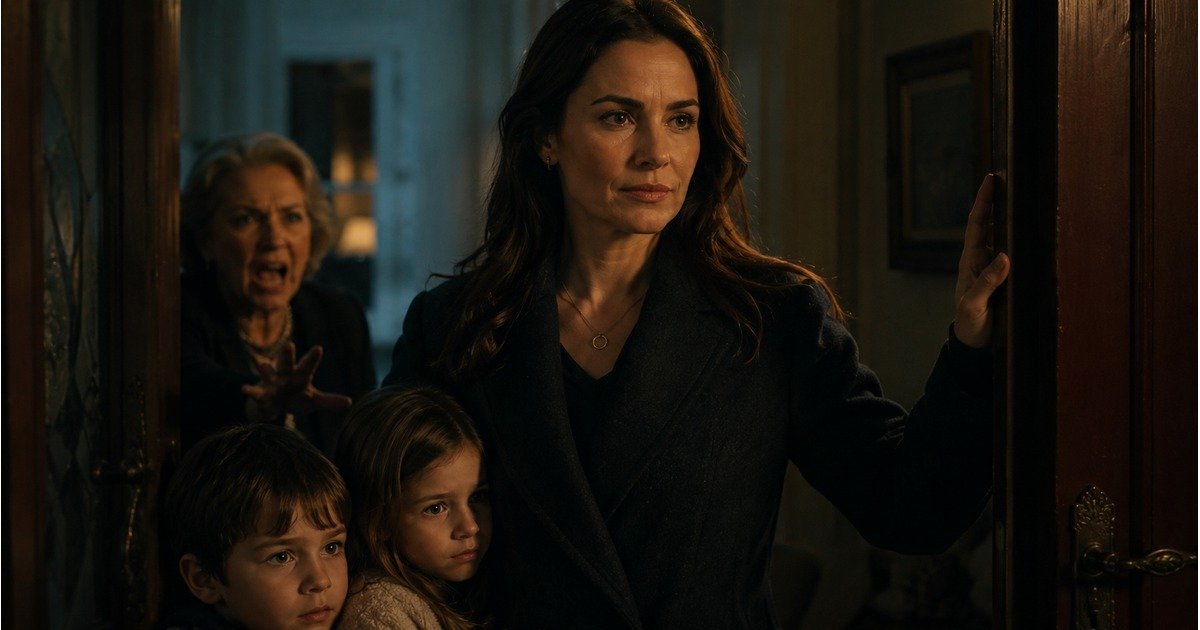
I want to be honest with you about who I was before this happened, because I think it matters.
I was the daughter who called every Sunday. I was the one who drove three hours each way to attend family events my husband had to miss because of work. I was the one who sent flowers on her birthday and Mother’s Day and sometimes just because it was a Wednesday and I had seen something that reminded me of her.
I was the good daughter. I had been the good daughter for thirty-six years.
And then, on a Tuesday afternoon in October, my seven-year-old came home from a visit to my mother’s house and asked me why Grandma said I was broken.
My name is Claire. I am thirty-six years old. I have two children — Lily, who is seven, and Mason, who is nine. My mother, Diane, is sixty-eight and has lived alone since my father passed four years ago. After his death, I increased every effort I was already making. More calls. More visits. More of my time and attention directed toward making sure she felt less alone.
I do not say this to make myself sound saintly. I say it because I need you to understand the context in which the thing that happened happened.
I need you to understand what “broken” cost coming from her.
My mother and I have always had what I would describe as a vertical relationship. She speaks. I listen. She criticizes. I absorb. She decides what a family gathering means and who plays what role in it. I comply and bring a dish and make sure my children behave in ways that reflect well on her.
I had learned, over thirty-six years, to manage this dynamic without calling it what it was. Therapists had words for it. I had read those words in books and highlighted sentences and had conversations with my husband about patterns I recognized. But naming it formally felt like a betrayal I wasn’t ready for.
So I kept calling on Sundays.
In the year after my father died, my mother began spending more time with my children directly — picking them up from school occasionally, having them for Sunday afternoons when I was working. I was grateful for this. I thought it was good for all of them.
I was not in the room for most of those Sunday afternoons.
Lily came home on the Tuesday in October quieter than usual. She ate dinner without the running commentary she usually provides. She asked, at bedtime, if I was okay.
I said yes, of course, why?
She looked at her hands.
“Grandma said you have problems from when you were little. She said you feel things too much and it makes you not able to handle things like other moms. She said we should be extra nice to you because you can’t really help it.”
I sat on the edge of her bed.
I made my face do something neutral.
I told her that Grandma sometimes said things in a confusing way, and that I was completely fine, and that she didn’t need to worry about me. I told her I loved her. I turned off the light.
I walked to the bathroom, ran cold water over my wrists, and stood there for a long time.
My husband found me there. I told him what Lily had said. He listened without interrupting, which is one of the things I love most about him, and then he said, very quietly, “That’s the last time.”
I called my mother the next morning.
I want to be accurate about this conversation, so I will tell you what I remember as precisely as I can.
I told her what Lily had told me. I asked her if she had said those things.
She said she didn’t remember exactly what she had said but that she had probably been trying to help the children understand me better.
I asked her why my children needed to understand me better.
She said that I had always been a sensitive child and that she had spent my whole life trying to help people around me accommodate that sensitivity.
I asked her what she had specifically told my children.
She said she had told them that I struggled sometimes and that they should be patient with me.
I said that my children were seven and nine years old and that their job was not to be patient with their mother.
She said I was being defensive.
I said I was being clear.
She said that she had only ever tried to help me and that it was very painful to be accused like this after everything she had done.
This is the part I want to be precise about, because it is the part I have replayed more times than anything else.
I did not shout. I did not say anything cruel. I did not list every grievance from the past thirty-six years, though the list exists and is long.
I said: “Mom, I need you to not speak to my children about my mental or emotional health. That is not information they need and it is not yours to share.”
She said: “So now you’re telling me what I can and can’t say to my own grandchildren.”
I said: “Yes. In this specific case, yes.”
She said that I had always had trouble accepting love and that this was exactly the kind of thing she meant.
I told her I needed to go. I ended the call.
That night, my husband and I talked for a long time. Not about what to do — I think I had already decided, without fully saying it yet — but about what the pattern actually was. We named it properly for the first time in our marriage. He had seen it clearly for years. I had been managing it too closely to see the shape of it.
The next day I called my mother and told her that I would not be bringing the children to see her for the foreseeable future, and that I needed space from contact with her while I figured out what kind of relationship, if any, was possible going forward.
She cried. She said I was punishing her. She said my father would be devastated. She said she had given her whole life to me and this was what she got.
I said I was sorry she was in pain. I said I would be in touch.
I have not called on Sunday in eleven weeks.
My brother — who has always occupied a different position in my mother’s world, which is a whole separate conversation — called me three weeks in to tell me I was being cruel. He said she was sixty-eight and alone and that whatever she had said to Lily was probably just a poorly worded attempt at being helpful.
I told him I understood his perspective.
He said family was family and people made mistakes.
I said yes.
He said was I really going to let this destroy the relationship.
I said I wasn’t sure yet.
We haven’t spoken much since.
My mother has sent two letters. Old-fashioned, handwritten, on her monogrammed stationery. The first was an explanation of her intentions, which were good, which she wanted me to understand. The second was an account of how much she had sacrificed and how little she had received in return.
I read both letters. I did not respond.
My children have asked about Grandma twice. I have told them, honestly, that Grandma and I are working some things out and that they will see her again when things are clearer. Lily accepted this. Mason looked at me for a moment and then nodded and went back to his homework.
He is nine years old and he nodded, as if he understood more than a nine-year-old should have to understand.
That, more than anything, confirmed to me that I had made the right call.
I am in therapy now. Proper, consistent, weekly therapy with someone who does not let me manage my way around the hard parts. We are working through thirty-six years of a particular kind of relationship and what it did to how I understand myself.
It is slow work. It is important work.
I do not know if I will have a relationship with my mother again. I know that sounds dramatic when I write it plainly. Sixty-eight years old. Alone. Her husband gone. The daughter who called every Sunday.
But I also know what I saw on my seven-year-old’s face when she asked me if I was okay.
She had been given a job she should never have had. A framing of her mother that a child should not carry. A story about me that belonged to no one but me — and that was not even accurate.
My mother had spent thirty-six years telling me who I was.
I am only recently learning that she was wrong.
Am I the asshole for going no contact with an elderly, widowed mother over something she may have said without understanding the impact — or are there some lines that, once crossed with your children, cannot be uncrossed?
Share this if you believe that protecting your children from a narrative about you is not just your right — it’s your responsibility.
Get Heartwarming Stories in Your Inbox
Join thousands of readers getting uplifting stories every week.