My son asked the question so quietly I almost didn’t hear it over the noise of the restaurant.
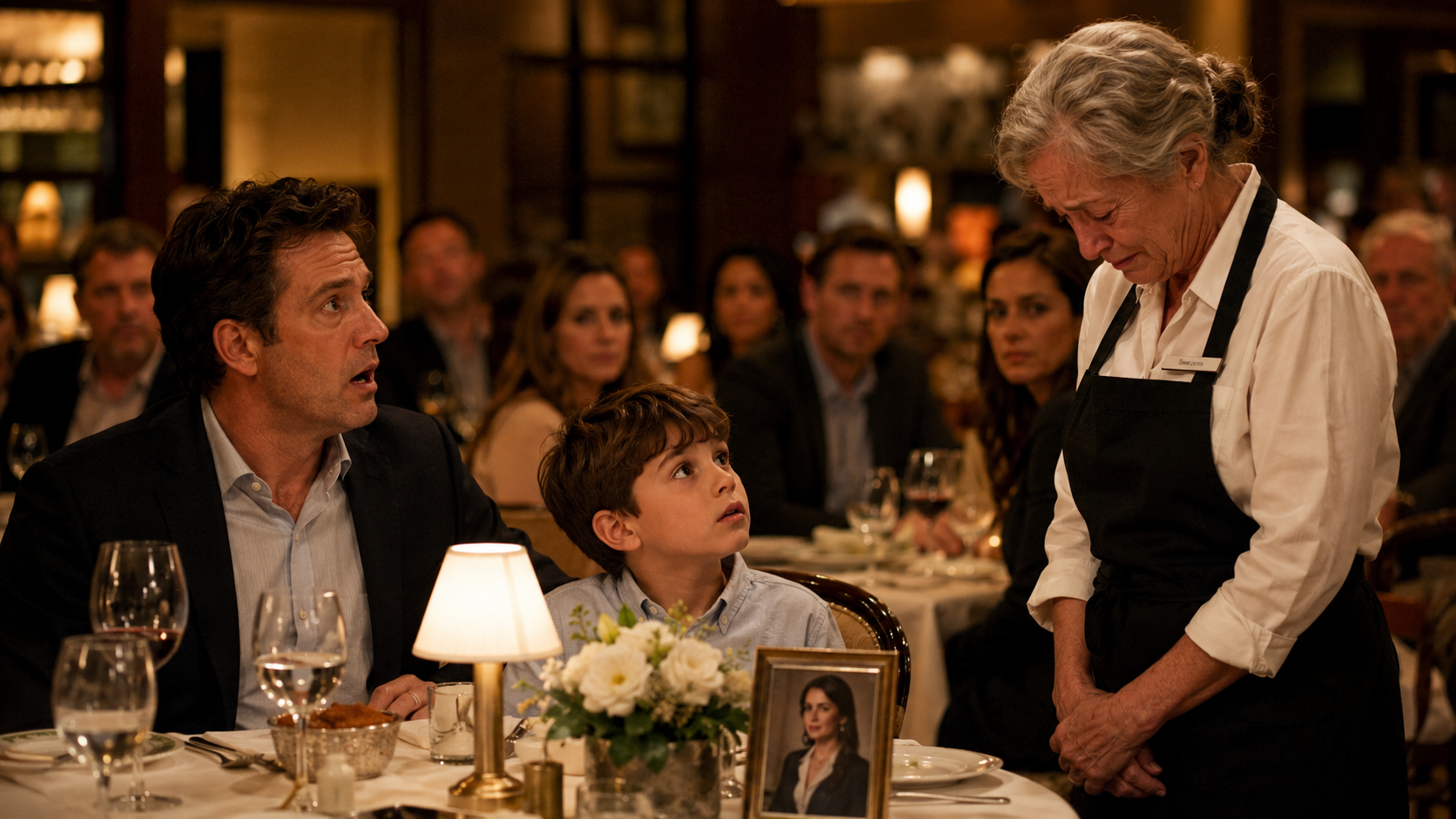
“Dad. Why does she always put flowers next to Mom’s picture before she brings our food?”
I had been mid-sentence. Complaining. Loud enough for the tables near us to shift uncomfortably in their chairs.
The words left me like air out of a punctured tire.
Helen, our waitress, had her eyes on the floor. Her hands were clasped in front of her. She was seventy-three years old and had been working at Crestwood Grill for longer than I had been coming here, and I had just told her, in front of my nine-year-old son and half the dining room, that she ruined our family dinner every single year.
I had meant it when I said it.
I didn’t mean it for long.
My name is Richard Calloway.
My wife, Claire, died twenty-six months ago. Pancreatic cancer. Eleven weeks from diagnosis to the last morning. Theo was seven years old. He still slept with the light on for eight months after.
I handled grief the way I handle most things I don’t know how to carry. I got efficient. I got impatient. I got very, very good at being somewhere else inside my own head while my body moved through the motions of being a present father, a functioning professional, a man who had his life together.
What I got very bad at was being kind to strangers.
Crestwood Grill had been our place since before Theo was born.
Claire loved it. Not for anything dramatic — just for the booths, the low lighting, the way the bread came out warm without anyone asking. She said it felt like a room that had already decided you were welcome.
We came every year on the same Friday in November. Her idea originally. A family dinner with no occasion, no celebration, just the three of us in our booth with too much pasta and whatever dessert Theo could be talked into sharing.
After she died, I kept coming.
I don’t know exactly why. Grief does strange things to routine. Some habits feel like betrayal once the person who made them with you is gone. This one felt like the opposite. Like showing up was the only way to tell her I remembered.
Theo always wanted to come. He never said why. I never asked.
I should have asked.
Helen had been our waitress every single time.
I registered that fact the way you register background details — her gray hair, her slight limp, the way she moved a little slower each year. She always remembered our order. Always had the bread ready when we sat down. Always placed a small arrangement of white flowers in the center of the table before bringing our menus.
I had never thought about the flowers.
I had never thought about a lot of things I should have thought about.
The night it happened, I was tired. A deal had fallen through that afternoon. Traffic had been brutal. Theo had been quiet in the car in that particular way that usually meant he was fine but I always interpreted as something I was doing wrong.
Helen took longer than usual getting to our table. When she arrived, she was slightly out of breath, and she set one of the glasses down harder than she meant to, and a little water spilled on the tablecloth.
I said something sharp.
Then I said something sharper.
I told her she was slow. I told her she always seemed to struggle with our table. I told her this was supposed to be a special dinner and she managed to make it stressful every year without fail.
Helen apologized. She was very quiet about it. She cleaned the spill with a cloth from her apron and said she was sorry for the trouble.
Nearby tables had gone still.
I didn’t care. Or I told myself I didn’t.
Then Theo spoke.
“Dad.”
His voice was small and completely serious. The voice he used when he was asking something he had been thinking about for a long time.
“Why does she always put flowers next to Mom’s picture before she brings our food?”
I didn’t understand the question at first. “What picture?”
“Mom’s picture. The one on the little stand at the end of our table. She brings it out every time we come and puts it there with the flowers before she does anything else.”
I looked at the end of the table.
A small wooden stand. A photograph in a simple frame. Claire, smiling, at a table I recognized as this one, in this booth, light falling the same way it fell right now.
I had not seen it. I had sat in this booth every November for two years and I had not seen it.
Or I had not let myself.
Helen had not moved. She was looking at the floor. Her hands were pressed together in front of her and I could see, from where I was sitting, that they were shaking slightly.
“Helen,” I said.
She looked up. Her eyes were already wet.
“That photo.” I stopped. Started again. “Did you put that there?”
She nodded once. Very small.
“Every year?”
“Every year you come. Yes.”
Theo was watching her with the focused attention children have when adults are finally saying something true.
“Dad,” he said. “I saw her at the cemetery last week.”
The restaurant was very quiet now.
“At Mom’s grave. She was putting flowers there too. She was crying.”
Helen closed her eyes.
I could not speak.
“I didn’t tell you,” Theo said carefully, “because I thought maybe it was a secret she was keeping for a reason.”
He looked at Helen.
“Were you friends with my mom?”
Helen asked if she could sit down.
I said yes. She sat in the empty chair at the end of our booth, the one we always left empty.
She told us that Claire had started coming to Crestwood Grill alone, on Thursday afternoons, about four months before she was diagnosed.
Not for any particular reason at first. She just liked the quiet. She liked the bread. She would sit in this booth and grade papers — she had been a third-grade teacher — and drink tea and stay for two hours without anyone bothering her.
Helen had been her regular server on those afternoons.
They had talked. The way you talk to someone when you are both just doing the thing you are there to do and the conversation happens without you deciding to have it. Claire had asked about Helen’s family. Helen had asked about hers. They had talked about Theo. About the school where Claire taught. About what it felt like to love a job that exhausted you.
After the diagnosis, Claire still came on Thursdays.
She told Helen before she told most people. Helen was not sure why. Sometimes people tell the truth to someone who is not fully inside their life because it is easier than watching the faces of people who love you change when they hear it.
Helen had sat with her.
Every Thursday for nine weeks.
And in the last week, when Claire could not come to the restaurant anymore, Helen had visited her at home.
Once.
“She asked me something,” Helen said. She was looking at Theo when she said it. “She knew about your family dinners here. She knew you would keep coming because she knew your father.” A small pause. “She said he keeps his promises even when they cost him.”
She took a breath.
“She asked me if I would make sure there was always a place set for her memory at that table. And she asked me to keep an eye on you.” She looked at Theo directly. “On both of you. From a distance. Without making a fuss.”
Theo absorbed this the way children absorb enormous things — completely, without performance.
“Did she know you would say yes?” he asked.
Helen smiled. It was the saddest smile I had ever seen on a person’s face. “She knew I would because I had lost a son. She knew I understood what it meant to want someone to look in on the people you were leaving.”
She folded her hands on the table.
“I have come to work every Friday in November for two years. I have made sure I was the one assigned to this section. I have put those flowers out and that photograph on the stand and I have watched the two of you eat dinner.”
She looked at me.
“I’m sorry I was slow tonight. My hip has been difficult this week.”
I don’t remember exactly what happened next in the order it happened.
I remember Theo getting up from his seat and hugging Helen without asking. I remember her putting her arms around him and pressing her eyes closed. I remember the table next to us being very quiet for a long time.
I remember going to the bathroom because I needed two minutes where no one could see my face.
When I came back, Theo was sitting beside Helen on her side of the booth, and she was showing him something on a small piece of paper — a note, I would learn later, that Claire had written and asked her to give to Theo when the time felt right. A few sentences. His mother’s handwriting.
He folded it and put it in his jacket pocket.
He has not shown it to me. I have not asked. Some things belong entirely to one person.
I apologized to Helen in front of the restaurant.
I stood up and I said, loud enough for the tables around us to hear, that I had spoken to her with cruelty she did not deserve, that I had been careless with someone who had been quietly carrying something for my family for two years, and that I was sorry.
She told me to sit down and eat before the food got cold.
I sat down and ate.
I spoke to the restaurant manager the following week.
I found out Helen had requested our section every November for two years. That she had purchased the flowers herself. That she had brought the photograph from her own home — Claire had given it to her on one of those Thursday afternoons, from her wallet, a duplicate she had made specifically for that purpose.
Claire had planned it.
She had planned for the photograph to be on our table. She had planned for the flowers. She had planned for someone to watch us from a distance and make sure we were still showing up.
She had known we would need someone to notice, even if we didn’t know we needed it.
Especially if we didn’t know we needed it.
Helen retired at the end of that winter.
We had dinner with her before her last shift. Theo chose the restaurant and insisted on the same booth. He brought her a card he had made himself, which took him four days and which I was not allowed to read before he gave it to her.
She cried when she read it.
She told us we were welcome to visit her. Theo said we would. He meant it in the way children mean things, which is completely.
We have been four times since spring. She makes tea and Theo sits at her kitchen table and does his homework while she watches television and neither of them seems to find this arrangement unusual.
I sit there too.
It is the quietest I feel all week.
People ask me sometimes what I learned from that night.
I tell them the easy version — that I was unkind to someone who deserved kindness, that I was caught by my own son’s clarity, that I was given a gift I didn’t recognize until it was almost gone.
The harder version is this.
My wife knew me well enough to know I would struggle. She knew I would get impatient and closed off and that I would move through grief like a man trying to outrun it. She knew I would come back to that restaurant every year because she knew I kept my promises even when they cost me.
And she arranged for someone to be there anyway. Someone who would put flowers on the table and a photograph in the right place and carry the memory of her into the room before we even sat down.
She made a plan for us from inside the last weeks of her life.
And a seventy-three-year-old waitress with a bad hip kept it without ever asking for a single thing in return.
I had called her slow.
I had called her an inconvenience.
I had done it in front of my son, who saw her at a grave with flowers in her hands and kept the secret because he understood, at nine years old, that some kindnesses aren’t ours to expose before their time.
He is a great deal wiser than I am.
He gets it from his mother.
You might also enjoy: The Principal Called My Son a Cheater. Then a Scientist Stood Up from the Audience.
So choose a side: Stand with Helen — a promise made to a dying woman deserved more than silence, and Richard needed to know. Or stay quiet — Claire asked her to watch from a distance, and that secret was never Helen’s to share.
Share this if you believe some people carry kindness so quietly the people they are carrying it for never even know — until a child asks the right question.
Disclaimer: Mention of any brand or trademark is for identification only and does not imply partnership or endorsement.
You might also enjoy: More Inspiring People Stories on KindlyTold
Get Heartwarming Stories in Your Inbox
Join thousands of readers getting uplifting stories every week.