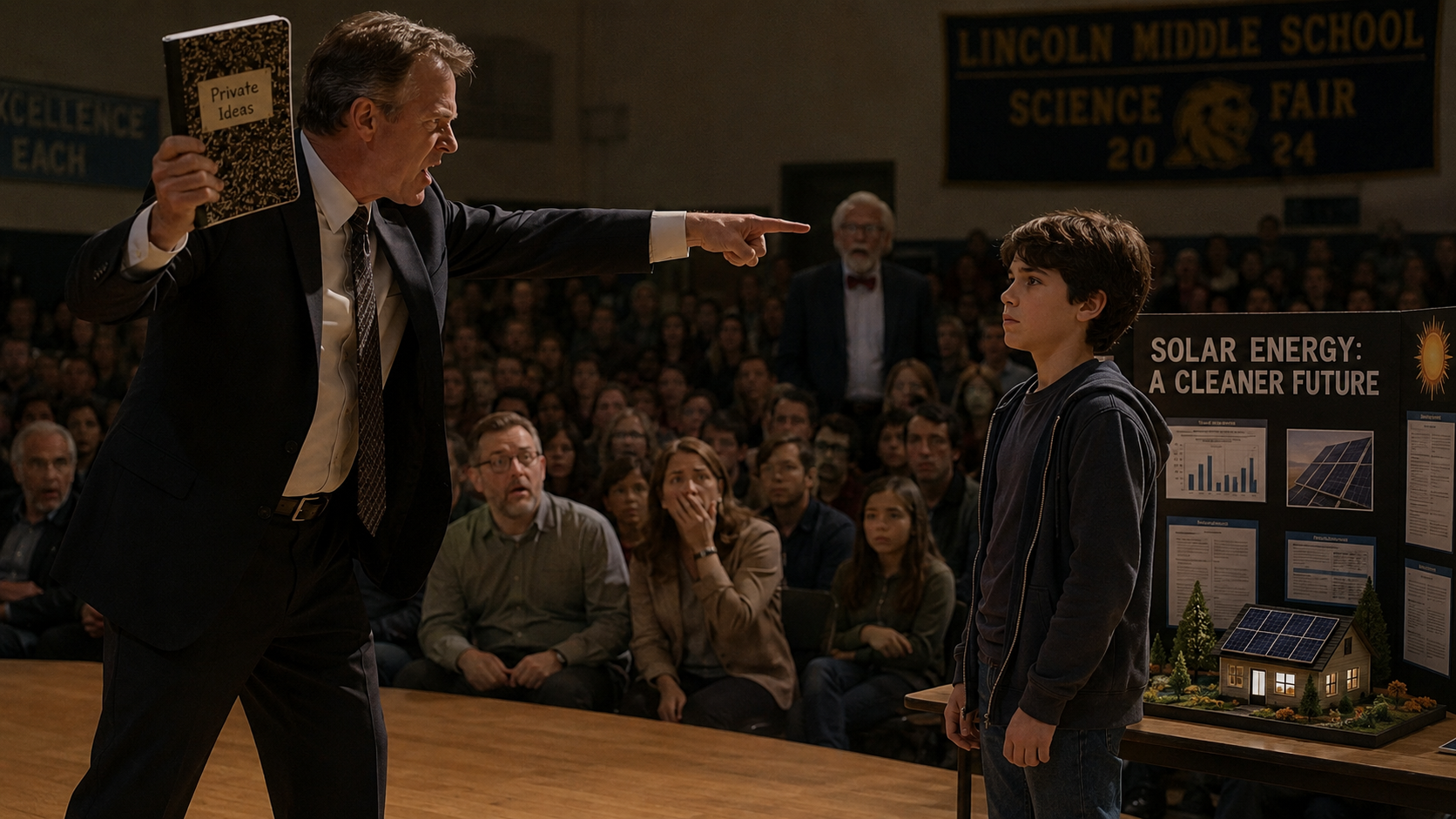
“Those handwritten formulas belong to a man I have been looking for for thirty years.”
Dr. Elias Grant said it standing in the middle of the auditorium, his voice cutting through every whisper in the room.
Principal Harmon was still holding my notebook in the air.
The camera flashes had stopped. The parents were no longer whispering. Three hundred people held completely still.
And I understood, for the first time, that my grandfather had not been a quiet man who happened to know a lot about science.
He had been someone the world had failed to see.
My name is Noah Webb.
My father cleans the floors of Hartwell Middle School every night from six to midnight. His name is James. He has worked at the school for eleven years. He knows every hallway, every bathroom, every classroom that smells different after rain.
He has worked there long enough that most students do not see him at all.
That is how invisible some people choose to make themselves.
It was also how my grandfather chose to live.
My grandfather, Henry Webb, died two years ago.
He was seventy-one years old and had spent the last twenty-two years of his life as a maintenance worker at a water treatment plant outside our city.
Before that, I did not know much. My father didn’t talk about it. My grandfather didn’t either.
He was a quiet man with large hands and a habit of sketching on whatever paper was nearby. Napkins. Receipt paper. The backs of envelopes. Always the same kind of shapes — coils, chambers, pressure calculations that made no sense to me when I was small.
When I got older, I started asking what they meant.
He would look at the sketches for a moment, then fold the paper carefully and put it in his shirt pocket.
“Something I’ve been thinking about,” he would say.
“For how long?”
He would smile. “A long time.”
He never told me more than that.
When he died, I found a brown notebook in his room. Thirty years of sketches inside. Dense, careful, methodical. The same shapes, evolved over decades, growing more precise with every page.
I didn’t understand most of it. But I recognized enough to know it was a system. A design. Something that wanted to be built.
My school’s regional science fair had an award ceremony every spring.
The top projects from each grade were displayed in the main auditorium, and winners were announced in front of parents, teachers, and that year, a special guest.
Dr. Elias Grant. Retired professor. Former director of the National Applied Sciences Institute. His name was on the program in bold letters.
I did not know who he was.
I had spent three months building a small atmospheric energy collection device based on the sketches in my grandfather’s notebook. I could not explain everything it was designed to do. But I understood the core principle — the device captured minute electrical charge differentials in humid air and stored them in a simple battery cell.
My science teacher, Mrs. Ola, had helped me write the report. She was the one who submitted it to the fair. She said it was the most original project she had seen in twelve years of teaching.
I did not tell her where the design came from. I did not fully know yet myself.
My project was selected as a finalist.
My father polished his shoes for the ceremony. He sat in the second row in a button shirt I had not seen before.
He did not know about the notebook. I had kept it quietly, the way my grandfather had.
Principal Harmon opened the ceremony. He was the kind of man who believed that rules were most important when other people were breaking them. He distrusted anything that surprised him.
When my name was called as a top finalist, I walked to the stage and stood beside my display.
Principal Harmon moved down the row of projects, asking each student questions. When he reached mine, he stopped. He picked up my written report and read for longer than he had read anyone else’s. Then he picked up the notebook.
I should have said something. I should have asked him to put it down.
But he was the principal, and I was twelve, and there are things your body understands before your mind catches up.
He held the notebook open and looked at the sketches. Then he looked at me.
“Where did you get these formulas?”
“My grandfather drew them.”
“Your grandfather.” He repeated it in the tone people use when they mean the opposite of what they’re saying. “And what was your grandfather’s background?”
“He worked maintenance. Before that I don’t know.”
Something shifted in Principal Harmon’s expression. Not curiosity. Satisfaction.
“These diagrams,” he said, loud enough for the first three rows to hear, “are not the work of a middle school student.” He turned to the audience. “Or of a maintenance worker.”
The room murmured.
My father’s face did not change.
Principal Harmon held up the notebook. “This project was not designed by this student. These formulas were copied from a professional source and presented as original work. That is academic dishonesty.”
A girl in the front row whispered something to her mother. A boy near the back laughed quietly.
I looked at my father. He was looking at me. Not with anger. With something worse. The look of a man who had expected something like this to happen eventually, who had spent his whole life waiting for exactly this kind of room.
“I didn’t copy anything,” I said. “My grandfather designed it. He taught me what it meant before he died.”
“Your grandfather designed it.” Principal Harmon’s voice dropped into something almost gentle, which is the cruelest version of that voice. “A maintenance worker designed a theoretical atmospheric energy capture system.”
“Yes.”
The room went quiet in that particular way that means everyone is embarrassed for you.
I did not look away from Principal Harmon. I was not going to look away.
Then someone stood up.
Not quickly. Not dramatically. Just a man in the fifth row, rising to his feet slowly, the way people stand when they are carrying something heavy.
He was tall. Gray-haired. Sixty-eight years old, though I would not learn that until later.
He did not say anything at first. He was looking at the notebook in Principal Harmon’s hands.
Then he began walking toward the stage.
The auditorium teacher moved to intercept him. He showed her a credential badge without breaking stride.
Dr. Elias Grant. The name on the program. The special guest.
He walked up the side steps and stood at the edge of the stage. “May I see that notebook,” he said. It was not a question.
Principal Harmon handed it over because there was no version of that moment where he didn’t.
Dr. Grant opened it. He looked at the first page. The second. He turned pages slowly at first, then faster. His hands were not steady.
He stopped at a page near the middle — the most complete of all the sketches. Three interlocking chambers with pressure annotations and a formula along the bottom that I had never been able to fully decode.
Dr. Grant read the formula. He read it again.
Then he lowered the notebook and looked at me for the first time.
“What was your grandfather’s name?”
“Henry Webb.”
The room heard him exhale. It was the kind of exhale that contains thirty years in it.
“Your grandfather,” Dr. Grant said quietly, “did not disappear from our research team.”
He looked at the audience. Then back at me.
“He was pushed out.”
Dr. Grant spoke for eight minutes. No one moved.
He explained that in 1994, he and Henry Webb had been junior researchers at the National Applied Sciences Institute, working on a project to develop low-cost atmospheric energy capture for off-grid communities. The lead was a discovery Henry had made — a formula that resolved a pressure differential problem the entire field had been working on for a decade.
When Henry went on emergency medical leave — my grandmother had been diagnosed suddenly — two senior researchers published the core findings under their own names.
By the time Henry returned, the paper had been circulated, the credit was established, and the institute’s position was that Henry’s contribution was “administrative support.”
Henry disputed it. He was told to sign a reassignment agreement or leave. He left.
He tried to continue the research independently. No funding body would touch a project where the foundational paper was already attributed to someone else. He filed a formal complaint. It was reviewed, then dismissed. He appealed. Dismissed again.
He never spoke about it publicly. He moved his family. He took the maintenance job. He kept sketching.
Thirty years. In notebooks. On napkins. On the backs of envelopes. Still solving the problem. Still believing it was worth solving.
He just stopped believing anyone would listen.
“I left the institute two years after Henry did,” Dr. Grant said. “I could not prove what happened. I could not find him. I spent years trying.”
He held up the notebook.
“He kept working. He never stopped. And he taught this boy enough to build a working prototype — not just of the original device, but of the evolved version. The version we never reached.”
He set the notebook down carefully on my display table. “This is not copied from anywhere. This is the original.”
Principal Harmon said something about verification procedures.
Dr. Grant looked at him with the kind of patience that has already calculated the distance between patience and complete disregard. “Then verify it,” he said.
They verified it.
Three independent researchers reviewed the notebook contents against the 1994 publication and all subsequent literature in the field. The core formula — the one I had never fully decoded — predated the published paper by eight months. The margin notes in my grandfather’s handwriting showed the evolution of the discovery from initial observation to proof.
The published paper had used his methodology without attribution.
The finding was forwarded to the institute’s ethics board, then to the journal that had published the original paper, then to the national academic integrity body.
The formal correction took fourteen months.
The published paper was updated with an amendment acknowledging Henry Webb as a primary contributor. A posthumous recognition was issued by the National Applied Sciences Institute — the first they had granted in forty years.
Dr. Grant testified personally at the hearing.
My father sat in the front row. He wore the same button shirt. He did not look like a man who cleaned floors. He looked like the son of someone the world had finally agreed to see.
My science project won the regional fair. Then the state competition.
A university research program offered me a summer placement based on the prototype. Dr. Grant wrote the recommendation himself. He said: “The methodology in this project represents not only exceptional scientific thinking for a student of any age, but the continuation of research that should never have been interrupted.”
He also said something smaller, at the end of the ceremony, when most people had left.
He put his hand on my shoulder and said: “Your grandfather knew what he had. He just ran out of room to say it.”
I thought about the notebook. The thirty years of sketches. The formula he never stopped refining. The way he would fold the paper and put it in his shirt pocket.
Something I’ve been thinking about. For a long time.
“He told me,” I said.
Dr. Grant looked at me.
“He just said it in sketches.”
Principal Harmon wrote a formal apology. It was addressed to me and to my father.
My father read it once, folded it, and put it in a drawer. He did not frame it. He did not show it to anyone.
I asked him once if it meant anything.
He thought about it. “An apology means something when it costs the person giving it,” he said. “That one came after everything was already done. It didn’t cost him much.”
I understood what he meant.
The apology was not the vindication. The vindication was a formula, finally attached to the right name, in a journal that the whole field reads.
The vindication was a boy standing at a science fair with a notebook full of his grandfather’s life’s work, not knowing what he was holding, building it anyway because it felt like the right thing to do with the only thing that man had left behind.
My grandfather never told me he had been wronged. He never asked me to fix it.
He just handed me the shapes and trusted me to recognize what they were.
People tell this story now like I walked into that auditorium knowing what would happen. I didn’t. I just built something from a notebook. A quiet man’s thirty years of mornings before work, lunches eaten alone, evenings at a kitchen table while everyone else watched television.
He did not get loud. He did not get angry. He just kept going.
That is the part I try to remember. Not the ceremony. Not the correction. Not Principal Harmon’s apology.
The part I try to remember is a man folding a paper napkin with a sketch on it and putting it in his shirt pocket, because the idea was worth keeping even if no room was ready to hold it yet.
You might also enjoy: The Exam Board Called His Score Impossible. He Asked to Retake It on the Spot.
So choose a side: Stand with Noah — the school owed that family a public apology long before the science community got involved. Or side with procedure — the principal was following protocol and couldn’t have known what he was looking at.
Share this if you believe a quiet man’s life’s work deserves to carry his name, no matter how long it takes.
Disclaimer: Mention of any brand or trademark is for identification only and does not imply partnership or endorsement.
You might also enjoy: More Inspiring People Stories on KindlyTold
Get Heartwarming Stories in Your Inbox
Join thousands of readers getting uplifting stories every week.


1 thought on “The Principal Grabbed My Son’s Notebook During the Award Ceremony and Called Him a Cheater in Front of Every Parent in the Room — Then a Scientist Stood Up from the Audience, Walked to the Stage, and Said the Words That Revealed What My Son’s Grandfather Had Hidden for Thirty Years”
Comments are closed.