My grandmother’s name was Vera, and she was a small woman who wore the same three housedresses on a rotating schedule and kept her silver hair pinned tightly at the back of her neck every single day of her life, including Sundays. She had come to this country from Slovakia in 1961 with one suitcase and a working knowledge of three words of English, and she had spent the following sixty years being quietly, immovably competent in a way that made everyone around her feel slightly less organized than they actually were. She could stretch a chicken three different ways. She could read weather from the color of the sky at dusk. She kept her financial records in a shoe box organized by rubber band into quarterly bundles, and she had done this every year since 1963 and had never once been wrong about what she had or where it was.
She moved into our basement in 2009, when I was nineteen. I was in community college at the time, living at home with my parents, and the arrangement seemed entirely natural – Grandma Vera was eighty-one and slowing slightly, and the apartment she had maintained alone for eleven years after my grandfather died was becoming more than she could manage. My parents set up the basement with a proper bedroom and a sitting area and a small table she could use for her puzzles, and she came downstairs every morning at six thirty and ate oatmeal in our kitchen and complained pleasantly about American coffee and that was simply how things were.
My Aunt Lorraine – my mother’s older sister – lived forty minutes away in a larger house with a husband who sold insurance and two adult children who had moved out years earlier. She visited Grandma Vera every few weeks, Sunday afternoons mostly, bringing bakery cookies that Grandma accepted politely and didn’t eat because she thought American bakeries used too much sugar. Lorraine had always been the managing type, the one who organized family gatherings and kept the calendar and made the phone calls. After Grandma moved in with us, Lorraine announced that she would handle Grandma Vera’s finances, since this was complicated and my parents were busy, and my mother, who found financial paperwork genuinely difficult, was grateful and agreed.
What this meant in practice was that Lorraine took possession of Grandma Vera’s checkbook, her bank account information, her Social Security card, and her Medicare documentation. She told my mother she had set everything up on automatic deposit and automatic payment and that it was all handled. My mother asked occasionally if everything was fine, and Lorraine said yes, everything was fine, and my mother, who trusted her older sister and disliked conflict and was also genuinely very busy, believed her and did not ask to see documentation.
I found the bank statements in 2018, nine years after Grandma Vera moved in. I was twenty-eight by then, living in my own apartment, visiting my parents on weekends when I could. That particular weekend I had come to help clean out a storage corner of the basement that had accumulated boxes since Grandma’s arrival. Grandma herself was sitting upstairs watching her stories. I was sorting through her things – carefully, setting aside anything that might be hers – when I found a coffee can on a low shelf beneath the utility sink. It was an old Folgers can with a plastic lid, the kind she had always used to store small things, and I almost set it aside without opening it because it was clearly hers and not mine to go through. Then I noticed the corner of a folded paper sticking out beneath the lid.
Inside were bank statements. Fifteen months of them, folded tightly and placed in the can in careful sequence. They were from Grandma Vera’s account at a regional bank I didn’t recognize – not the bank I had ever heard mentioned in connection with her finances. The statements showed monthly Social Security deposits of one thousand and forty-eight dollars. They showed, on the same date each month, an automatic transfer to an account I didn’t recognize for nine hundred and fifty dollars. After nine years, that was a number that my mind began working out before I wanted it to.
I sat on the floor of the basement for a long time. Then I folded the statements carefully, replaced them in the can, and went upstairs and called my mother from my car.
My mother’s first response was that there must be an explanation. This is what people say when the alternative is unbearable. She said Lorraine was probably depositing the money into a nursing home fund, a savings account she was building for Grandma’s care in case she ever needed placement. She said Lorraine had always been responsible and we shouldn’t jump to conclusions. I listened to all of this and said yes and then I asked my mother when she had last seen a statement from Grandma’s account, or any documentation from Lorraine about how the money was being managed. The silence on the other end of the phone lasted long enough to be an answer.
It took six weeks to get the full picture, because getting the full picture required navigating bank privacy regulations and a family system that had been built specifically on the assumption that no one would look carefully. What we eventually found, with the help of an elder law attorney my mother engaged in November of that year, was that Lorraine had been transferring the majority of Grandma Vera’s monthly Social Security income into a joint account she controlled, for the entirety of the nine years Grandma had lived in our basement. The running total, including interest the account had accumulated, was just under one hundred and nine thousand dollars.
Grandma Vera, during those nine years, had been housed and fed by my parents and had received none of her own income. She had occasionally asked Lorraine for small amounts – twenty dollars for a birthday card, a new pair of slippers – and Lorraine had provided these things out of the account, which allowed her to tell herself, presumably, that she was being generous with someone else’s money. Whether she had a more elaborate rationalization than that, I honestly don’t know. People who do things like this over long periods of time tend to develop explanations that satisfy them internally, and I have given up trying to understand the specific mechanics of hers.
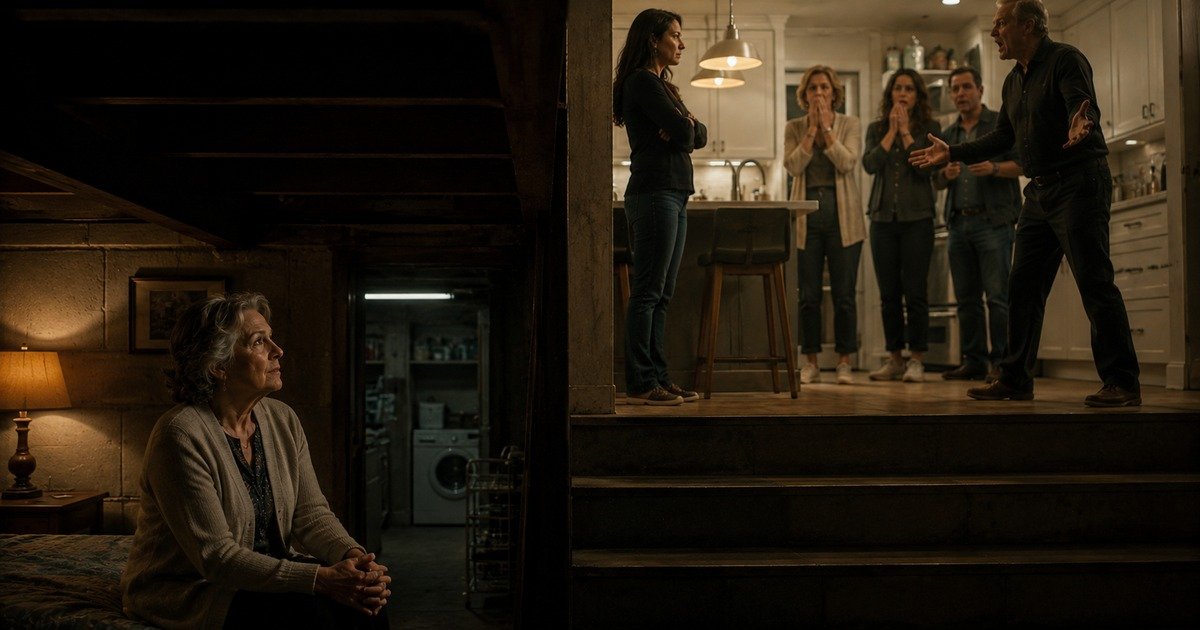
The conversation with Lorraine happened at my parents’ house on a Sunday in December. My mother had asked her to come for what she described as a family matter. Lorraine arrived with a tin of Christmas cookies and a shopping bag containing wrapped gifts. She sat down at the kitchen table and looked at the attorney and then looked at the bank statements my mother placed on the table and said nothing for a very long time. Then she said: Vera never wanted to be a burden to anyone.
My mother asked her what that meant. Lorraine said she had been managing things in a way she thought was sensible. My mother asked her to explain how transferring Vera’s income to a private account for nine years was sensible, and Lorraine said it was complicated, that there had been expenses, that she had been planning to settle things properly when Vera passed. My mother looked at her older sister for a long moment and then said, very quietly: She’s ninety. She’s still here. And you’ve been stealing from her for nine years.
Lorraine left the cookies and the gifts and drove away. The legal process took another fourteen months. Restitution was reached through civil proceedings rather than criminal charges, which was my mother’s choice and not one I agreed with entirely, though I have come to understand it. She did not want to put her mother through the spectacle of a criminal trial in her nineties. She wanted Vera’s money back and Lorraine out of her life. Both of those things happened.
Grandma Vera lived to ninety-three. She never fully grasped the details of what had happened – or if she grasped them she chose not to dwell there, which may have been wisdom rather than confusion. She continued to come upstairs at six thirty every morning and eat her oatmeal and complain about the coffee. The last year of her life she was frailer and slept more and sometimes called me by the name of a sister who had died in 1974, which I always answered to, because what would have been the point of correcting her.
I have thought many times since about the coffee can. About why Grandma Vera had those particular statements hidden in a can under the utility sink rather than in her organized shoe box with everything else. Whether she had found them somehow, whether she had suspected something she couldn’t name, whether she had put them there as a record she wanted someone to eventually find. I don’t know. I’ll never know. But I found them, and I am the granddaughter who spent nine years making her coffee upstairs while she watched her stories in the basement, and I am glad it was me.
Get Heartwarming Stories in Your Inbox
Join thousands of readers getting uplifting stories every week.