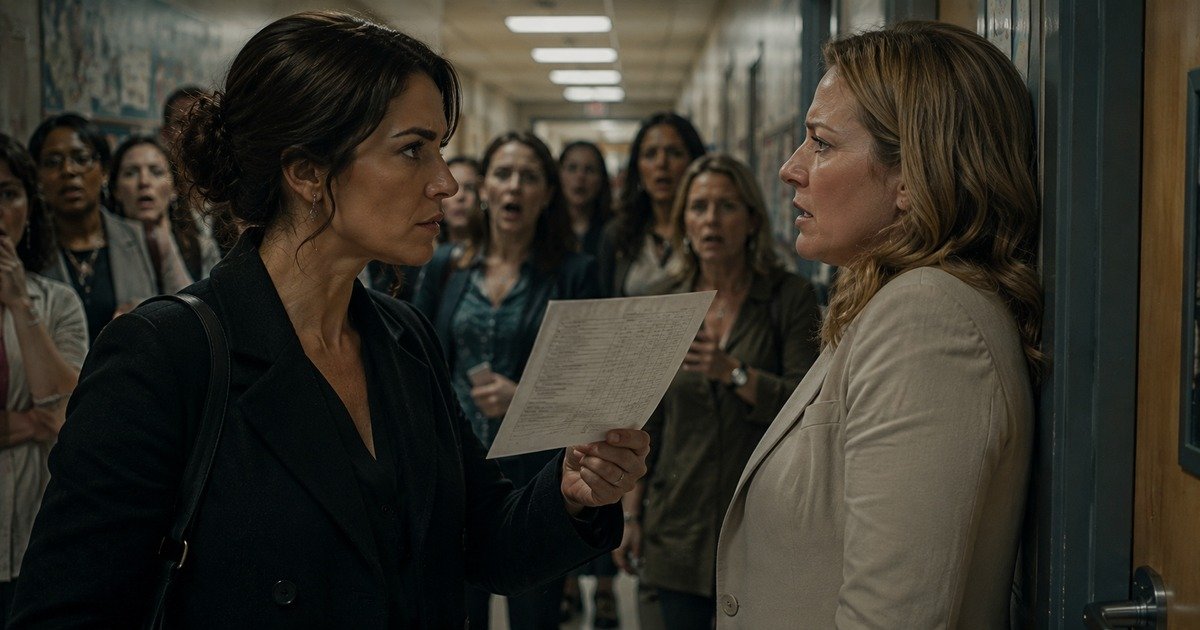
She said it on a Sunday afternoon in April, standing in her own kitchen while she arranged flowers in a vase her son had given her for Mother’s Day the previous year. She didn’t look at me when she said it. That was the part I remembered longest afterward – how she kept her eyes on the flowers, pulling stems and snipping ends with small scissors, as if what she was saying was too ordinary to require direct eye contact. You’re a lovely girl, Renata. But you’re not really one of us. I think you know that. Then she smiled pleasantly and asked if I wanted more coffee.
I had been married to her son Daniel for four years at that point. I had attended every birthday, every holiday, every Sunday dinner that involved potato salad made from a recipe I was never given and conversation conducted partly in Polish when something important was being said and the family didn’t want me to follow along. I had smiled through years of small exclusions that were individually too minor to protest and collectively devastating. I had brought food that was praised too enthusiastically and then never touched. I had given gifts that were accepted with expressions of polite confusion. I had listened to stories about Daniel’s childhood and his previous relationship and his years in college that were told as if I wasn’t present, as if my absence from those years made me irrelevant to any version of Daniel that really mattered. And I had stayed, because I loved him, and because I understood that families are complicated, and because I believed, foolishly perhaps, that time and consistency and patience would eventually accomplish what direct confrontation could not.
What I had not accounted for was that his mother, Irena, was not complicated so much as deliberate. The exclusions were not careless. They were a strategy, and she had been executing it for four years with the calm efficiency of someone who has never doubted that she will win.
I drove home from that Sunday in April without telling Daniel what she had said. He would have been upset, and then he would have called her, and she would have denied it or softened it past recognition, and I would have emerged from the whole exchange looking like someone who misunderstood something innocent. I had watched that happen before with smaller things. I understood the mechanics of it by now. So I said nothing. I folded what she had told me into a quiet place inside myself and I started thinking.
What I had not told his family – what I had never made a point of mentioning, because I was raised to believe that your accomplishments were not arguments – was that I had been running my own business for seven years. An interior design firm that I had started from nothing in the spare bedroom of a small apartment I rented alone before I ever met Daniel. It had grown steadily through years of work that started before six in the morning and ended after midnight. I had seven employees. I had a client list that included three boutique hotels and a restaurant group and more private residences than I could keep in my head without checking the folders. The previous year we had done just over one point two million dollars in revenue.
The Kowalski family knew I worked in design. They knew I had a studio. Beyond that, I had never elaborated. I dressed simply. I drove a sensible car. I did not talk about money because it seemed to me that people who talk about money as proof of their value have already lost some argument I don’t want to be part of. But sitting in my car in the parking lot of a grocery store in April, still hearing Irena’s voice saying you’re not really one of us while she snipped flower stems, I thought about the Thanksgiving dinner that was seven months away. I thought about the full table, the whole family assembled the way they assembled every year. And I thought: all right, then.
Daniel’s brother Piotr had been trying unsuccessfully for two years to secure financing for a restaurant he wanted to open. His sister Marta’s husband had been quietly looking for new work for eight months after a restructuring at his company. His cousin Basia had a daughter finishing design school who hadn’t been able to find a position anywhere that paid more than twelve dollars an hour.
In May, I hired Basia’s daughter. She was talented. I had seen her portfolio once at a family dinner and said so, and everyone had nodded politely and moved on, but I had meant it. I gave her a real position with a real salary and told her she had six months to show me what she could do. She started crying at the kitchen table when I called her. She said she had sent out forty-seven applications. I told her to stop applying elsewhere and come in on Monday.
In June, I connected Marta’s husband with a client of mine who was looking for someone with exactly his background in logistics management. I didn’t announce this. I simply made the introduction and let it develop on its own. He started the new position in August.
In September, I had lunch with Piotr. I told him I had reviewed the business plan he had shared at a family dinner the previous Christmas – the one that everyone had listened to politely and never mentioned again – and that I thought the concept was strong but the financial model had two specific problems that were fixable. We talked for three hours. I introduced him to a colleague of mine who arranged small business financing. The loan came through in October.
I did none of this as a calculation. Or rather – I did it partly as a calculation and partly because when I sat down and thought about what being part of a family actually meant, separate from whether anyone had decided to grant me membership, this was the clearest answer I could find. You show up. You pay attention to what people actually need. You use what you have to help where you can. That is the whole of it, or the most important part of it.
Thanksgiving arrived on a cold Thursday in November. The table was the same as always – the good tablecloth, the dishes that only came out twice a year, the candles Irena lit with the particular ceremony she brought to small rituals. I sat in my usual seat, which was near the end of the table and slightly apart from the main conversation in the way that had always been the case without anyone having to arrange it deliberately.
Piotr spoke first, early in the meal, before the dishes had even finished being passed. He raised his glass and said he wanted to say something. The table quieted. He talked about the restaurant, about the financing, about the opening date that was now confirmed for January. Then he said my name. He said I had done something for him that nobody else had been willing to do, which was to sit across from him and tell him the truth about his plan and then do something about it. He said he didn’t know how to thank me properly.
Marta’s husband spoke next. Then Basia, about her daughter, who was sitting at the far end of the table looking at her plate.
The table was quiet for a moment afterward. Daniel’s hand found mine under the tablecloth. I didn’t look at Irena immediately. When I did, finally, her expression was not what I expected. I had expected something defensive, or calculating, or simply unreadable in the way it often was. Instead she looked, for the first time since I had known her, genuinely uncertain. As if a version of events she had constructed carefully over years had just revealed itself to contain a structural flaw she hadn’t anticipated.
She said my name – just my name, nothing attached to it. Then she looked back at her plate.
We have not had a dramatic reconciliation. Real life does not usually work that way, and I have learned to be skeptical of transformations that arrive too suddenly and completely. But she calls me now. Occasionally, not constantly. She asks questions about the business sometimes, careful questions, as if learning the shape of something she misread for a long time. Last month she asked if I might ever look at Piotr’s restaurant space and offer an opinion on the interior. I said I would be happy to.
What I understand now, that I didn’t in April when I sat in a parking lot deciding what to do, is that belonging is not something another person can withhold from you permanently. It can be delayed. It can be made uncomfortable. But it is ultimately constructed from the same material as everything else that lasts: not by demanding recognition but by being, quietly and consistently, the kind of person a family eventually cannot imagine being without.
I never became one of them, exactly. But I never needed to. I became something more useful than that – I became indispensable, and that is a kind of belonging that no one can take back, even when they very much intended to.
Get Heartwarming Stories in Your Inbox
Join thousands of readers getting uplifting stories every week.