I need to start by saying I’m not proud of what I did.
But I’m also not going to pretend I would do it differently.
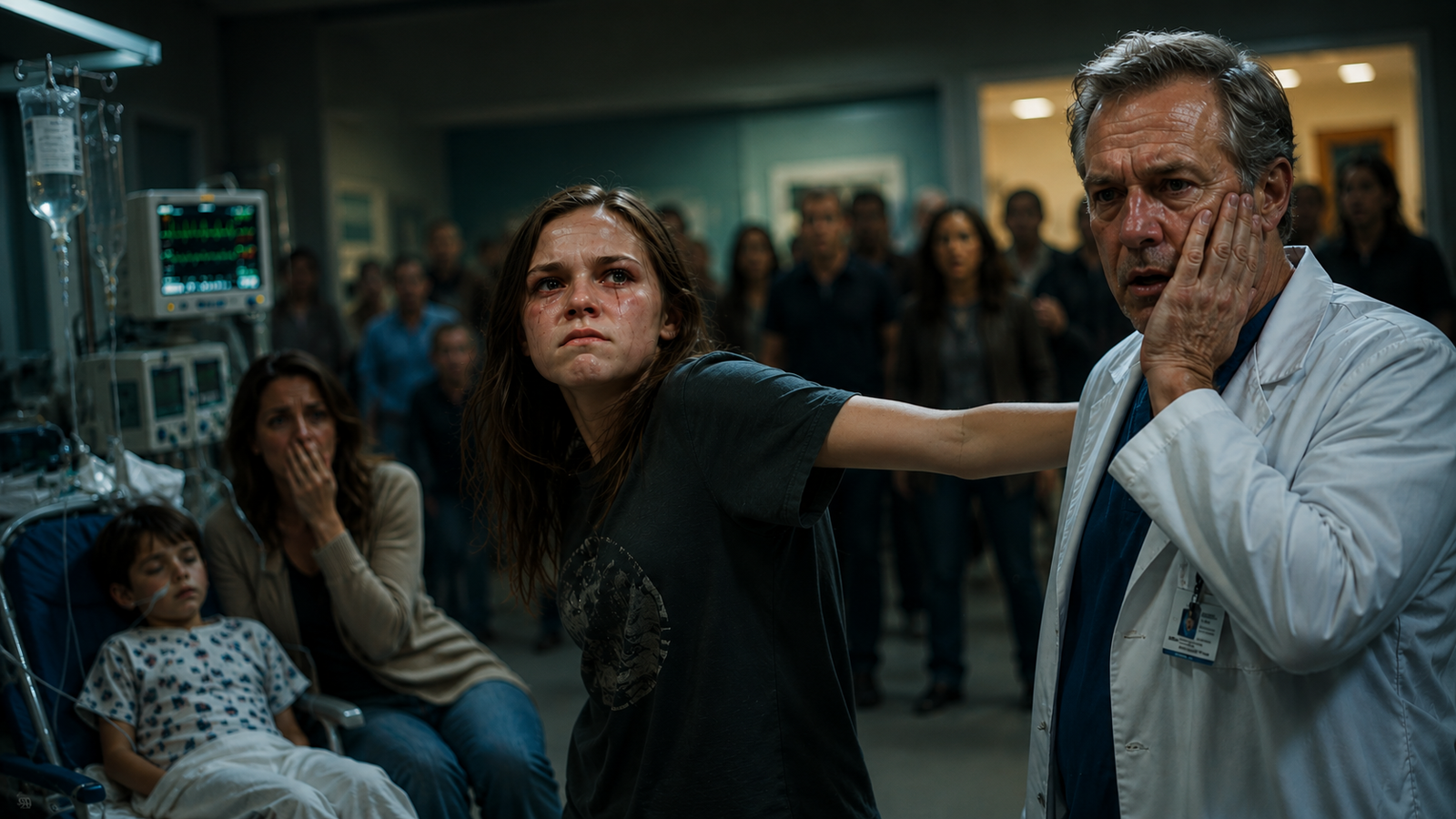
My brother Eli was six years old the night I slapped a doctor across the face in a hospital waiting room in front of forty strangers. I was sixteen. My mom was sitting next to me. And the man I hit was calmly explaining, in a measured professional voice, all the reasons we couldn’t afford to save my little brother’s life.
Here’s how we got there.
My father’s name was Robert Calloway. If you grew up in our city, there’s a reasonable chance you’ve stood inside something he built without knowing it. The convention center annex. The bridge overpass on the east side of downtown. The performing arts addition at Westfield High. And the north wing of Mercy General Hospital — the one with the wide corridors and the skylights that let natural light into the surgical suites — which he completed the year I was born and which he always said was the project he was most proud of.
He wasn’t a famous man. He didn’t want to be. He ran a mid-size construction and development company with about sixty employees and a reputation for doing things right the first time, which in his industry was rarer than it should have been. He was the kind of person who remembered every employee’s birthday, showed up to job sites in the same boots he’d had for twelve years, and believed — genuinely, not as a performance — that the work you left behind mattered more than the money you made from it.
He used to take me to job sites when I was small. I remember standing in the steel skeleton of a building before the walls went up, looking at all this raw structure and trying to understand that my dad had organized all of this — all these beams and crews and timelines — into something that would outlast all of us. He’d crouch down next to me and say, “You see this? This is what stays.” He meant it every time he said it.
He and my mom had been together since they were nineteen. She was the kind of person who made every room feel easier just by being in it — warm, steady, endlessly patient in a way that I’ve never been able to replicate. They were one of those couples you could just tell, watching them, had built something real. Not perfect. Real.
Eli was born when I was ten. I want to be honest about the fact that I wasn’t thrilled at first — I was ten, I had been an only child for a decade, and suddenly there was this small screaming creature who required everything from everyone at all times. But he had this way of looking at you when you picked him up, like you were the most important thing he’d ever seen, and I was gone within about a week. He had my dad’s eyes. That same quiet steadiness in them, even at six months old. Like he was already patient with the world.
My dad died when Eli was two and I was twelve.
A stroke. Sudden. He was fifty-one years old and in good health by every measure that anyone had thought to check, and then one Tuesday morning he was there and by Tuesday afternoon he was gone. There was no warning. No preparation. No goodbye that we knew was a goodbye. My mom got the call at 2pm and I was at school and by the time I got home she had aged in a way that I hadn’t thought was possible in the span of a few hours.
The years after my dad died were hard in ways that I’m still sorting out.
He had life insurance. He had some savings. He had the company, which his business partner eventually bought out at a price that my mom later told me was probably lower than it should have been but she was too exhausted and too grief-stricken to fight. She went back to work — she’d been a bookkeeper before she left to raise us — and she did everything right and worked every hour she could and still it never quite added up the way it had when my dad was alive. We moved to a smaller apartment when I was fourteen. We stopped eating out. We stopped the vacations we used to take. Small things disappeared one by one so gradually that I barely noticed each individual loss, only the accumulated distance from the life we’d had before.
She never complained. That’s the thing I want you to understand about my mother. She never — not once — sat down with me and said this is hard or I’m struggling or I don’t know how we’re going to do this. She just did it. Every day she got up and did it.
Eli was diagnosed with a heart condition when he was five. I don’t want to go too deep into the medical details because they’re his and not mine to share, but the short version is this: he needed surgery. Not immediately, but definitely. The kind of surgery that couldn’t wait past a certain window, and that window was narrowing faster than any of us had expected.
My mom spent four months trying to navigate insurance, payment plans, assistance programs, everything. I watched her make calls every night after dinner, sitting at the kitchen table with the same stack of papers and the same careful, exhausted voice. I watched her sell things. Her jewelry, first. Then the car — she started taking the bus. Then things I’d thought of as permanent fixtures of our life that turned out to be sellable. She didn’t tell me she was selling them. I’d just notice something was gone.
I was sixteen when we ended up in the Mercy General waiting room at eleven o’clock on a Thursday night.
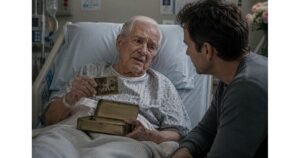
Eli had had an episode earlier in the day — nothing catastrophic, but serious enough that his doctor had sent us to the hospital for monitoring. We’d been there for three hours. The waiting room was full — families at different stages of exhaustion and fear, a few people sleeping across chairs, a nurse moving through periodically with that particular efficiency that hospital staff develop when they’ve seen too much to stop moving. It smelled like antiseptic and old coffee.
The doctor who came to speak to us was not Eli’s regular doctor. He was a hospital administrator type, the kind of person whose job seems to be at the intersection of medicine and finance. He sat across from my mom in one of those plastic waiting room chairs and he opened a folder and he started going through numbers.
The surgery cost. The projected recovery. The gap between what insurance would cover and what it wouldn’t. The payment plan options, which were not really options at the numbers he was describing. He spoke the way people speak when they’ve delivered this kind of information many times — not unkind exactly, but insulated. Practiced. The way you talk about things when you’ve learned to keep them at a certain distance.
My mom listened. She nodded. Her hands were in her lap and I could see them, and they were shaking slightly, and she kept them very still the way she does when she doesn’t want anyone to see that they’re shaking.
Then she said, in a voice that was very quiet and very even: “I’ve already sold everything I own.”
The doctor paused. He made a small sympathetic sound. He began to explain, again, the payment plan structure.
I don’t know exactly what happened in me in that moment.
I’ve thought about it a lot since. I think it was the combination of things — the shaking hands my mom was trying to hide, the four months of phone calls and sold jewelry, the way the doctor was looking at his folder instead of at her face, the smell of the hospital, the sound of Eli somewhere in the back hooked up to monitors, the fact that we were sitting in a building my father had helped build while someone explained to my mother why she couldn’t afford to save her son.
I stood up.
I walked the three steps to where the doctor was sitting.
And I slapped him across the face.
The waiting room went absolutely silent. Not gradually — instantly. Every conversation stopped. The ambient noise of the room just ceased. I could hear the monitors distantly beeping somewhere in the back.
The doctor stared at me. My mom said my name. I don’t know what my face looked like. I was crying, I realized, though I hadn’t noticed starting.
“Her father,” I said — and my voice was louder than I meant it to be, louder than anything in that room, and I couldn’t seem to make it quieter — “built half this hospital before he died. We are sitting in a wing that my father built. And you are sitting here telling my mother she can’t afford to save her son inside a building that our family built, and I need you to understand that I will not sit quietly while you do that.”
The words came out in one long sentence. When they were done the room was still silent.
The doctor had his hand raised slowly to his face. He was looking at me differently now — not with anger, which is what I expected. With something else. Something uncertain.
He said, very carefully: “What was your father’s name?”
I said: “Robert Calloway.”
Something happened to his face.
It’s hard to describe. It wasn’t quite recognition — it was more like recognition hitting something already half-remembered. His hand was still at his cheek. He lowered it slowly.
“Robert Calloway,” he repeated. Not a question. Just the name, held out in front of him like he was checking something.
He stood up. He said, “Please wait here,” and his voice had changed — the practiced administrative tone was gone and something more human had replaced it. He walked quickly down the corridor toward the administrative wing.
My mom was looking at me. The forty people in the waiting room were looking at me. I sat back down next to my mom and she put her arm around me and I started really crying then, the kind of crying where you can’t control the sound of it.
The doctor came back seventeen minutes later.
He had a different folder. He sat down across from us again, and he looked at my mom, and he said: “Mrs. Calloway. I owe you an enormous apology. I should have known who you were when you came in. That is a failure on our part, not yours.”
He explained what I hadn’t known and what my mom, in her grief and her years of moving forward with her head down, had never thought to ask about.
When my father completed the north wing of Mercy General, he had negotiated something unusual into his contract. Not more money. He had negotiated a provision — a formal, legal, documented provision — that granted his immediate family lifetime access to care at Mercy General, including surgical procedures, at no cost. His lawyer had drafted it. The hospital board had signed it. It was on record in the hospital’s contract files, twenty-two feet from where we were sitting.
No one had thought to look it up when we checked in.
No one had connected the name.
My brother’s surgery — all of it, every dollar — was already covered. Had always been covered. Had been covered since before he was born, by a quiet negotiation my father had made during a project he’d described as the one he was most proud of, in a building he’d said was going to stay.
Eli had his surgery six weeks later. He came through it well. The surgeons were careful and the recovery was slow and there were hard days, but he came through.
He’s seven now. He has my dad’s eyes and a scar on his chest that he’s already decided he’s going to show to people his whole life, because he says it proves he survived something. He’s not wrong.
I went back to that doctor about a week after the waiting room night. I needed to apologize for the slap. Whatever he’d said or hadn’t said, whatever the circumstances were, hitting someone is wrong and I knew it and I needed to say it directly. He met with me for about twenty minutes. He was more gracious about it than I deserved. He said he understood, that he’d thought about our conversation a great deal, and that he was going to recommend some changes to the intake process so that a family’s history with the hospital would be surfaced earlier.
I don’t know if those changes happened. I hope they did.
My mom doesn’t talk about that night very often. When she does, she doesn’t talk about the slap or the waiting room or the silence. She talks about my dad. About how like him it was, to have quietly arranged something like that. To have thought ahead, in the middle of a project he was proud of, to the people he loved and the things they might one day need.
“He was always building something,” she said once. “Even when we didn’t know he was building it.”
I think about that a lot.
The north wing of Mercy General still has the skylights. I’ve been back a few times since Eli’s surgery. I always look up at them when I walk through — that natural light coming down into the long corridor, the way it moves through the day. My dad put those skylights there because he believed that sick people deserved to see the sky. He said it in a meeting and apparently it took some convincing, and he convinced them, and there they are.
That’s what stays.
Some people will tell you what she did was wrong. Others will say there are moments when wrong and right aren’t the point. Which side are you on?
Share this if you believe some fathers keep protecting their families long after they’re gone. And share it if you think a daughter fighting for her brother — even imperfectly — is something worth remembering.
Get Heartwarming Stories in Your Inbox
Join thousands of readers getting uplifting stories every week.