Carol had the journals.
She offered to send them. I said I needed a week to think about whether I was ready. She said she understood and would wait as long as I needed. She waited exactly one week and then I called her and said yes.
There were fourteen journals, spanning from 1959 to 2012. They arrived in a cardboard box wrapped in brown paper, packed carefully with bubble wrap. I sat with the box on my kitchen table for two days before I opened it.
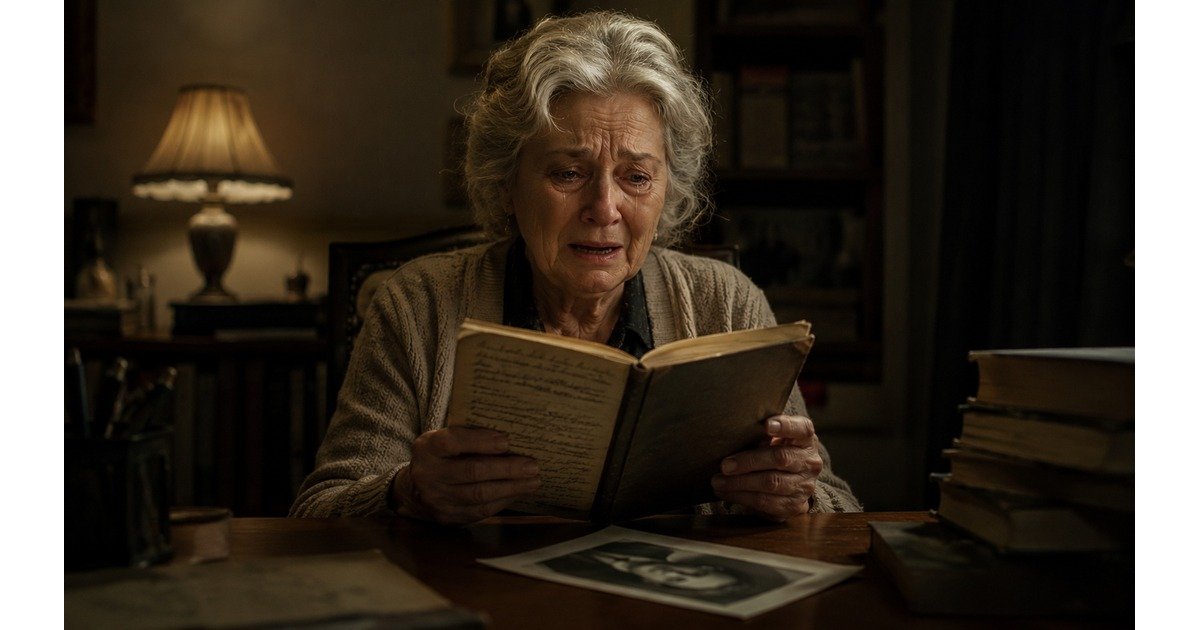
I read them over the course of three weeks. My daughter came to stay with me for the second week, not because she was needed but because she sensed I should not be alone with it.
Ruth was an extraordinary writer. Her journals were full of music and books and the specific details of a quiet life lived attentively – the garden she kept, the students she taught, the light in her kitchen in the early mornings. She had a dry humor and a precise eye and a capacity for self-reflection that I recognized in myself with a jolt that was physical, almost disorienting.
She wrote about me in the first journal and then not again for many years and then, starting in her sixties, more frequently. She wrote about wondering. She wrote about hoping. She wrote one entry in 1999 – I would have been thirty-eight years old – that said only: “I hope she has had enough love. I hope the people who raised her were kind. I hope she knows, somehow, even without knowing where the knowing comes from, that she was not given away but placed carefully and deliberately by someone who had no other way to love her properly at the time.”
I read that entry four times.
I called Carol and read it to her over the phone. We cried together for a while, two women in their sixties who had never met in person, connected by a woman neither of us would see again.
I visited Carol in Michigan the following spring. We had lunch and walked along the lake and talked for six hours without running out of things to say. She gave me a photograph of Ruth at thirty, standing in a garden, squinting slightly into the sun. I have my mother’s nose. I have her hands.
I placed carefully. By someone who had no other way to love me properly at the time.
I hold onto that sentence the way you hold onto something that was always yours but took a long time to find.
Share this with someone who was adopted or who loves someone who was. Every story of where we come from is also a story of love finding its way.
On Searching for Origins and Finding Something Unexpected
She was sixty-two years old when she began the search. That is not a small thing. For six decades she had carried the particular identity of someone adopted at birth — loved, secure, told the truth from childhood — and still, the question remained. Not a wound, exactly. More like a door that had always been there, which she had simply never opened.
Searches like hers have become more common in the age of DNA testing and ancestry databases, but the emotional landscape they traverse has not changed. What does a person hope to find? Often it is not a replacement family or a correction to the one they grew up with. It is something quieter — a medical history, a face that resembles their own, an explanation for traits that seemed to come from nowhere.
What this story captures so precisely is the way identity can be both settled and unfinished at the same time. She was not lost. She was not searching because something was broken. She was simply ready, at sixty-two, to know. And the world she found on the other side of that search — whatever it contained — added to her story rather than replacing it.
For anyone in a similar position, waiting for the right moment to search, wondering whether it is worth the uncertainty, stories like hers offer something important: permission. Permission to be curious. Permission to want to know. Permission to hold two complete families in your heart at once without it meaning anything is diminished. There is more room in a life than we sometimes think.
Get Heartwarming Stories in Your Inbox
Join thousands of readers getting uplifting stories every week.