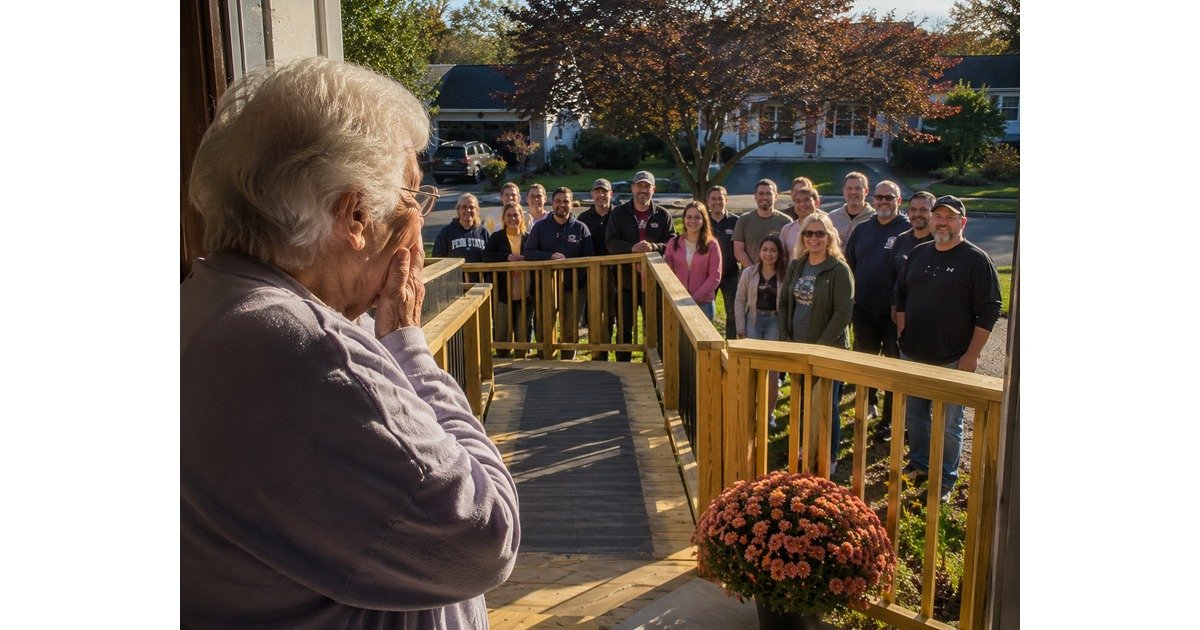
The following Friday evening, while Lisa took Dorothy out for what she’d described only as “a slow dinner,” eleven neighbors descended on Dorothy’s front porch. James had drawn up plans. Another neighbor, a retired electrician named Tom, handled safety lighting. A woman named Carmen who’d taken a carpentry class fifteen years ago turned out to be, in James’s words, “the best builder on the crew.” Two teenage brothers from down the street hauled lumber and held boards without complaint for four hours straight.
They worked by floodlight until midnight. They painted it to match the porch trim — Dorothy’s porch was white with green trim, the same colors it had been for 52 years. They added grip tape on the slope, a handrail on each side, and a small landing platform at the top so a wheelchair could turn around comfortably. Someone brought flowers in a pot and set them beside the ramp. Someone else hung a small welcome mat at the top that read: Home.
When Lisa pulled into the driveway with Dorothy just after midnight, the porch light was on. The ramp gleamed white in the dark. Dorothy didn’t say anything for a long moment. She just looked at it.
“What is this?” she finally said.
“This,” said James, stepping forward from the small crowd of neighbors who had stayed to see her face, “is your porch.”
Dorothy Hawkins, who had survived two recessions and one hurricane, pressed her hand to her mouth and cried like a child. Lisa wasn’t doing much better. Neither was James, if we’re being honest.
The next morning, Dorothy rolled herself out onto that porch for the first time in four months. She sat there in the morning sun with her coffee and watched the street wake up — the dog walkers, the school buses, the mail carrier she’d been giving cookies to for eleven years.
She waved at everyone who passed. Most of them already knew the story. They waved back like she’d never left.
Because as far as the neighborhood was concerned, she hadn’t.
When a Neighborhood Becomes What It Is Supposed to Be
Seventeen people. Three weeks. In secret. This is not a small coordination problem. Seventeen people keeping a secret for three weeks while simultaneously organizing something meaningful requires not just goodwill but actual discipline — the willingness to trust that the others are doing their part, to stay aligned on a plan, to resist the ordinary impulse to mention it to one person who might mention it to the wrong person.
What they did together is an example of something that urban planners and community organizers talk about but rarely manage to manufacture: genuine local solidarity. Not the performance of community — the yard signs and the Facebook groups — but the thing itself. People who noticed a need and decided, together, that they were going to address it. Not because they were required to. Not because there was a committee or a budget. Because they lived near each other and they were paying attention.
The experience of being on the receiving end of this kind of organized care is hard to describe accurately. It is not just gratitude, though there is gratitude. It is something closer to the sudden and vivid awareness that you are surrounded by people who see you — that the distance most modern neighborhoods maintain is not the only possibility, that behind the closed doors on your street there are people who, given the chance and the reason, will show up.
It took one person’s need and seventeen neighbors’ response to produce something no single actor could have generated: proof that this particular block is the kind of place where people take care of each other. That knowledge, once demonstrated, does not disappear. It changes what the neighborhood is.
Get Heartwarming Stories in Your Inbox
Join thousands of readers getting uplifting stories every week.