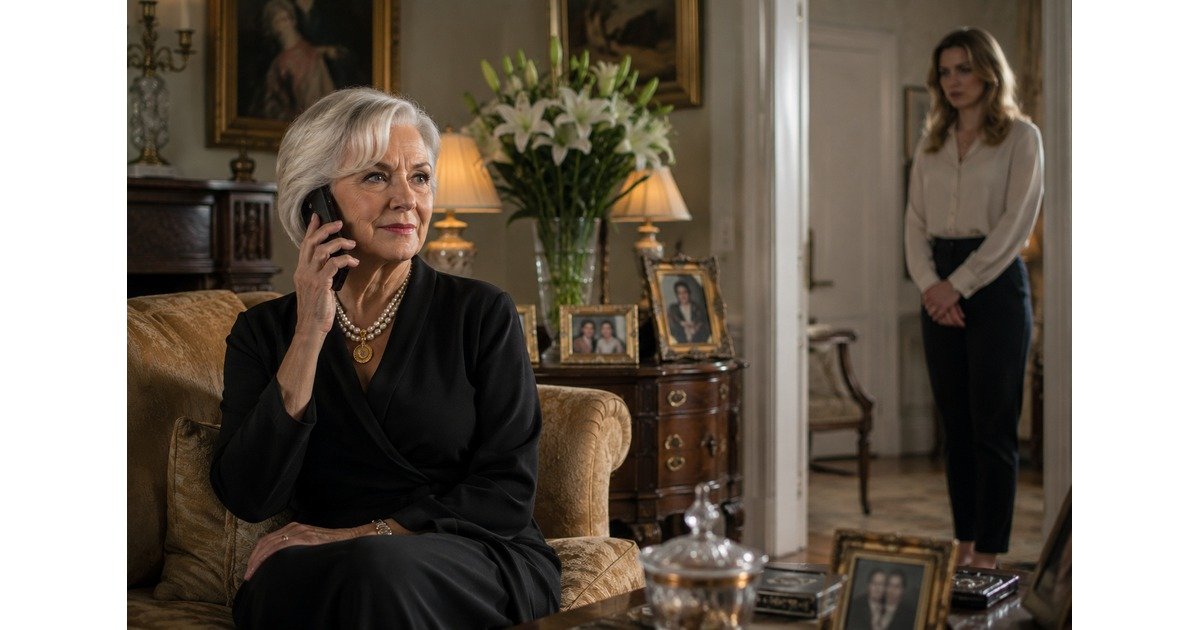
My attorney, Carol, had handled my affairs for fourteen years. She was seventy-one herself, sharp as a new blade, and she had heard versions of this story before. When I sat across from her desk and explained what had happened at Sunday dinner, she listened without interrupting. Then she opened a folder and slid three documents across to me.
“You did the right thing coming in,” she said. “Let’s make sure the house stays exactly where it belongs.”
Within forty-eight hours, the deed had been transferred into a living trust with conditions so specific that no one — not Derek, not Brenda, not any future claim they might construct — could touch that property while I was alive without my written, witnessed, notarized consent. Additionally, Carol drafted a letter that arrived at my son’s office on a Thursday morning, three days after Sunday dinner.
I was told later that Brenda read it first. That she went very quiet. That she asked Derek to read it himself and then read it again.
The letter was not threatening. It was simply thorough. It outlined the legal standing of the property, the terms of the trust, and — politely, professionally — the consequences of any future attempts to pressure an elderly homeowner into surrendering her primary residence.
Derek called me that evening. His voice was different from Sunday. Smaller.
“Mom, we didn’t mean it the way it sounded.”
I let him talk. I have found, at sixty-eight, that people often need the chance to hear their own explanations out loud before they realize how little those explanations hold up.
When he finished, I said: “The house is mine, Derek. It was mine the day you were born and it will be mine the day I decide otherwise. That day has not come. When it does, I will decide. Not Brenda. Not you. Me.”
There was a long pause.
“I know,” he said quietly. “I’m sorry.”
I told him I loved him. Because I do. But love does not mean handing over everything you built to people who confuse your age with your weakness.
Brenda has not brought it up again. The oak tree in the backyard is still mine. So is every room in this house. So is every year I spent building the life that made it possible.
I am not getting any younger. That much is true. But I am also not getting any more patient with people who look at a woman my age and see something they can take.
They were wrong about that. My lawyer made sure they knew it.
On Territory, Family, and the Places We Call Home
A house is not just a structure. It is, for most people, the most concrete expression of their autonomy — the place where their habits rule, where their preferences are embedded in the arrangement of furniture and the contents of cabinets. When someone else arrives and begins to reorganize that space, to announce plans that treat the house as their own project, what is threatened is not just comfort. It is identity.
The dynamics between mothers-in-law and daughters-in-law have generated entire libraries of commentary, most of it either too clinical or too comedic to be useful. What gets lost in the stock narratives is the specific texture of each situation — the way power moves in a family, who holds it formally and who holds it informally, and what happens when those two things come apart in the same household.
Her daughter-in-law’s announcement did not emerge in a vacuum. It came from a relationship with her son, from assumptions about who has authority over what, from possibly a lifetime of watching how families work and deciding that this was how her family was going to work. Understanding that does not make the announcement acceptable. But it makes it legible.
What she does with that understanding — whether she sets a boundary, has a conversation, withdraws, or something else entirely — depends on what she values most in this chapter of her life. But the first step is recognizing that what happened was not random. It was a move in a negotiation that was already underway, whether or not she had known it was happening. She did not start this. But she gets to decide how it continues.
Get Heartwarming Stories in Your Inbox
Join thousands of readers getting uplifting stories every week.