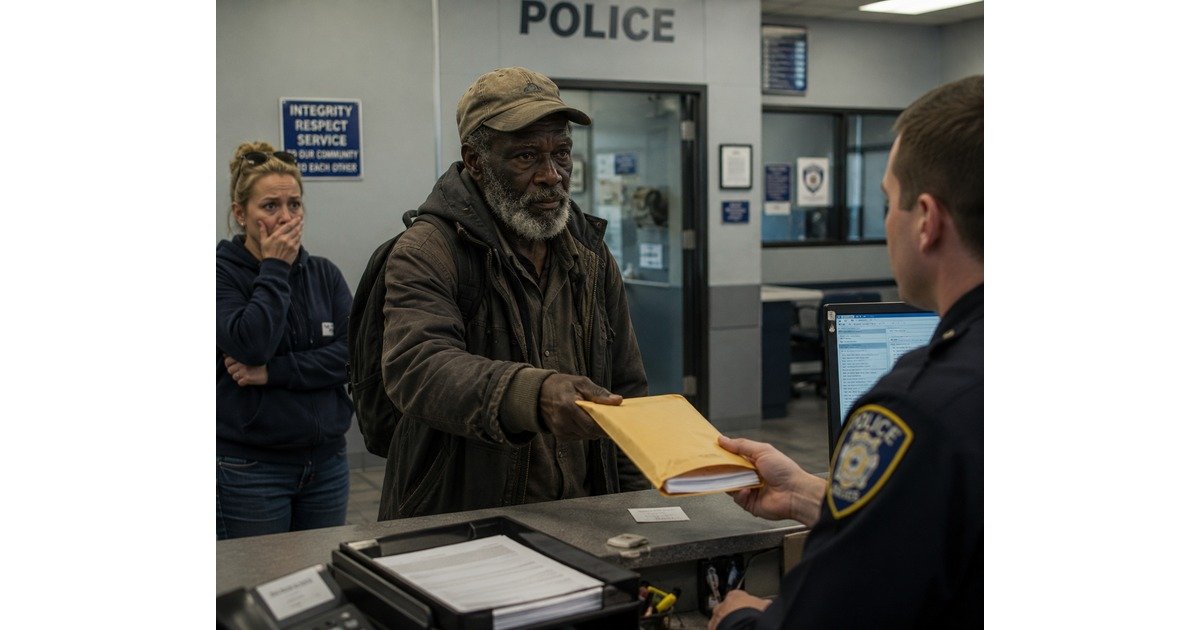
The bag belonged to a 67-year-old woman named Helen Park, who had withdrawn the cash to pay for her daughter’s emergency medical procedure — her insurance had denied the claim, and the hospital required payment upfront. Helen had realized the bag was gone within an hour and was, by the time Raymond walked into the precinct, in a state of quiet devastation. She’d filed a report, but she held little hope.
When an officer called her and said a man had turned it in — everything intact, not a dollar missing — Helen sat down on her kitchen floor and stayed there for a while.
She asked for Raymond’s name. She was told he’d left without giving it, but an officer who recognized him from the neighborhood knew where he could usually be found. Helen went there herself, the next morning, with her daughter beside her.
She found Raymond outside that same coffee shop. She sat down on the ground beside him — in her good coat, on the cold pavement — because she wanted to be at eye level when she spoke to him. She told him what the money was for. She told him what finding it returned meant. And then she handed him an envelope.
Inside was $3,000 in cash, a letter of recommendation to a workforce reentry program she had helped fund through her nonprofit, and a personal note that read: “Integrity like yours is rarer than any amount of money. The world needs more of you in it.”
Raymond read the note twice. Then he looked up at Helen and said: “You didn’t have to do any of this.”
“Neither did you,” she replied.
Raymond enrolled in the workforce program three weeks later. He completed it in four months, faster than anyone in his cohort. He is currently employed as a logistics coordinator at a supply company — the same field he worked in before his injury. He has his own apartment. He still volunteers at the shelter on weekends.
He keeps Helen’s note in the front pocket of his work bag. He says it’s the first thing he looks at when a day gets hard.
Helen’s daughter had her procedure. She is doing well.
What Integrity Looks Like When No One Is Watching
Ten thousand dollars in cash. Found on the street. No witnesses. No surveillance. No obligation of any kind, legal or social, to do anything other than keep walking or slip it into a pocket. He was homeless, which means he had more reason than most people to keep it and less protection than most people against the consequences of having it. And still, he made a different choice.
Stories about honesty tend to be most affecting when they involve people who have the least to gain from it. It is relatively easy, in the abstract, to imagine returning a found wallet when you are comfortable — when the money inside would not change the fundamental conditions of your life. It is significantly harder to imagine doing the same thing when you are sleeping outside, when that amount of money could represent months of stability, when no one would ever know.
His choice reveals something about character that cannot be explained by circumstance alone. Character is not a product of having things to protect or a reputation to maintain. It is something else — a set of commitments about who you are that persists even when enforcement is impossible, even when the pragmatic calculation runs clearly in the opposite direction.
The coverage that followed, the assistance that came his way, may have looked like a reward from the outside. But he did not know that was coming when he made the decision. He made it alone, in a moment when no one was watching, with no information about what would follow. That is not a performance of virtue. It is virtue itself, in its simplest and most honest form.
Get Heartwarming Stories in Your Inbox
Join thousands of readers getting uplifting stories every week.