Tom spent eleven days in the hospital. His sister stayed at his house to care for Oliver, who — according to her — barely ate and spent most of his time sitting by the front door. “He knew,” she said. “I don’t know how to explain it, but he knew Tom wasn’t home.”
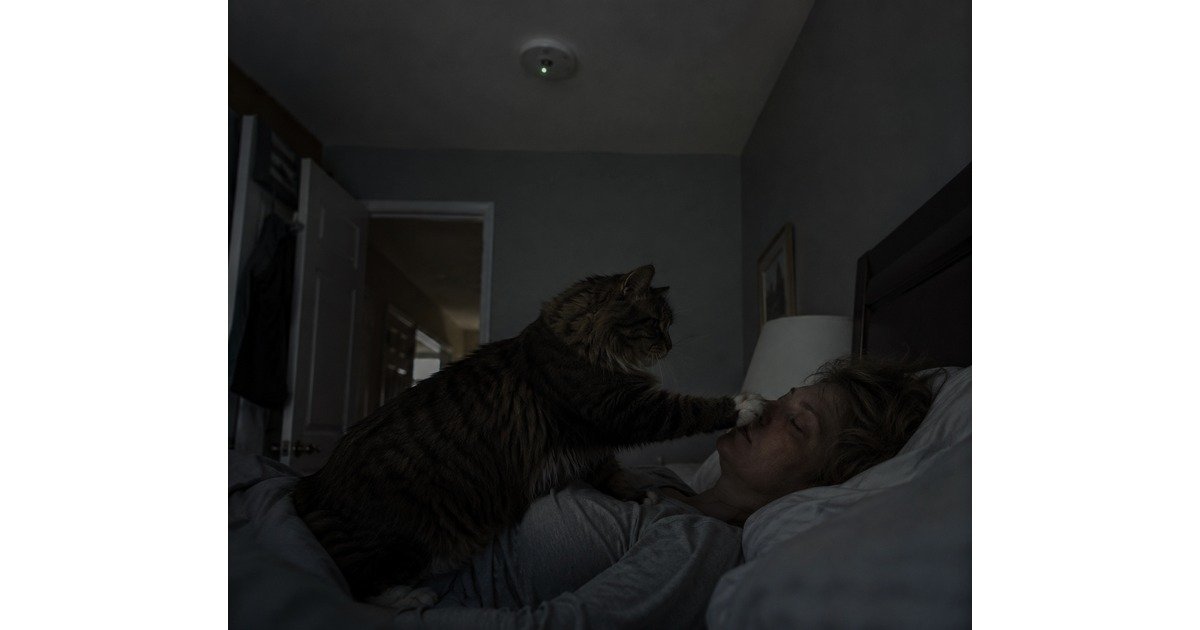
When Tom came home, thin and tired and moving carefully with a cane, Oliver did not rush him the way he usually did. He walked up slowly, sniffed Tom’s hand, and then pressed his entire body against Tom’s leg and stayed there, rumbling with the deepest, most continuous purr Tom had ever heard.
During Tom’s four months of home recovery, Oliver did not leave his side. When physical therapists came to the house for sessions, Oliver sat nearby and watched with great seriousness. When Tom napped, Oliver napped on top of him. When Tom had bad days — and there were bad days — Oliver was simply, quietly, constantly there.
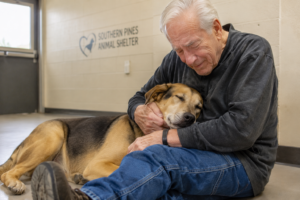
“I’ve had a lot of time to think about all of it,” Tom said recently. “About what I would’ve done if he hadn’t been there. If he hadn’t been the kind of cat who paid attention.” He paused. “I think about that shelter he came from. About how nobody wanted him for eight months. About how I almost got a dog instead.” He smiled. “Everything happens exactly the way it’s supposed to.”
Tom’s neurologist, who has treated stroke patients for over 20 years, heard the full story at a follow-up appointment. He sat quietly for a moment after Tom finished. Then he said: “I’ve seen a lot of things in this job. But every once in a while, something comes along that I just can’t explain by medicine alone.”
Tom is back at work part-time now. Oliver greets him at the door every evening, as he always has. The only difference, Tom says, is that now he always crouches down and holds the cat for a moment before he takes his coat off. A small ritual. An acknowledgment.
You never really know who’s saving who.
On Being Wanted After You Have Learned to Expect Otherwise
Six months at the shelter. That is a long time for a cat to wait. Long enough to learn that the people who come and go and look and leave are not going to be the ones who stay. Long enough for the hope that arrives with each new visitor to grow smaller and quieter and eventually to barely register at all. The animals that wait longest tend to be the ones people overlook — not young enough, or not the right color, or carrying some quality of stillness that gets misread as unfriendliness.
They have often been there long enough to have their own reputation: the one nobody wants. The staff knows their names. They get walked and fed and cared for, but they do not get chosen. Until, one day, they do.
What happens when they are finally chosen is not a simple transaction. The animal that has waited carries the history of its waiting. Trust does not arrive all at once. It is rebuilt slowly, in small increments — a hand extended and not pulled away, a voice that sounds the same each morning, a lap that is consistently available. The learned expectation of being passed over has to be unlearned before the new experience can take hold.
For the human on the other end of this process, there is often something unexpectedly meaningful in being chosen back. The animal that took the longest to trust, when it finally extends that trust, tends to extend it completely. It is a different kind of gift than the immediate affection of an easier animal. It is the gift of someone who had good reason not to, and chose to anyway. And that is, in its own quiet way, one of the most remarkable things in the world.
Get Heartwarming Stories in Your Inbox
Join thousands of readers getting uplifting stories every week.