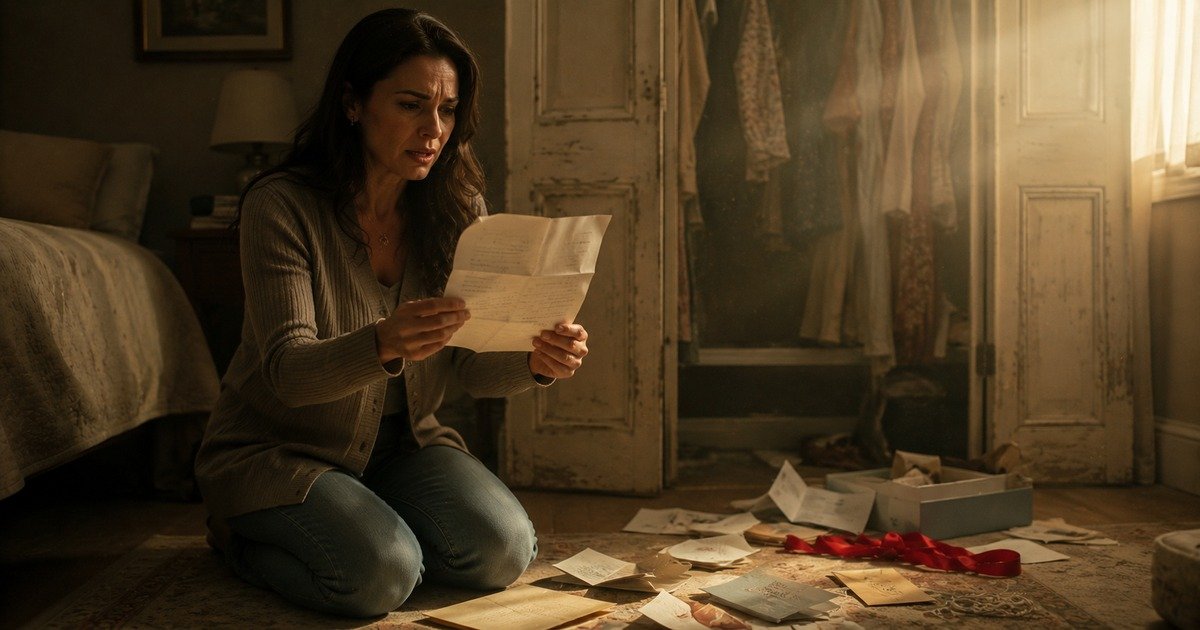
I found the letters on a Tuesday afternoon in November, three weeks after we buried my father, while I was doing the one task nobody else in the family had been willing to do. My mother couldn’t bring herself to touch his things. My younger brother Marcus had flown back to Portland the morning after the funeral, claiming work obligations, though I suspected it was grief he was running from rather than any deadline. So it fell to me, the way most things in our family fell to me – quietly, without discussion, simply because I was the one still there.
His closet smelled like him. Old Spice and cedar and something underneath both of those things that I couldn’t name but recognized immediately as purely him. I had started with the easy things – dress shirts still in dry-cleaning plastic, dress shoes lined up precisely on the floor, the row of neckties he hadn’t worn in years but refused to throw away. I was methodical about it the way grief sometimes forces you to be, organizing everything into donate and keep piles, grateful for the distraction of small decisions. Then I reached the top shelf.
There was a shoebox up there, pushed far back behind a stack of old tax folders. Ordinary looking. Worn at the corners. I almost didn’t open it. I very nearly set it directly into the donate pile without even lifting the lid, and sometimes now I think about that version of myself – the one who set the box aside and went home and never knew – and I wonder whether she was luckier than me or just more blind.
The box held letters. Dozens of them, bundled in stacks and tied with red kitchen string. Each stack was organized by year, stretching back to 1993. The envelopes were addressed in my father’s handwriting – careful, slanted slightly to the left the way he always wrote – to a name I had never heard. Patricia Oakes. The address was in Knoxville, Tennessee. We had never lived in Tennessee. We had no family in Tennessee that I knew of. I sat down on the floor of my father’s closet with the shoebox in my lap and pulled the string off the oldest bundle with hands that were already unsteady.
The first letter was dated March of 1993. I was eleven years old in March of 1993. My father had written in his careful hand about the weather in Cincinnati, about a promotion he had just received at the plant, about how he was enclosing something to help with the month. He signed it the way you sign a letter to someone you love – not formally, not distantly, but with warmth that was entirely familiar to me and simultaneously devastating because it was warmth I recognized as real. He closed with: Give her my love, Patty. Tell her she is always in my heart.
I sat there for a long time without reading further. The closet was very quiet. Outside, my mother was watching television in the living room, the sound of some afternoon program drifting faintly through the walls. I remember thinking how strange it was that ordinary life continued making its ordinary sounds while everything inside me rearranged itself into something I didn’t yet understand.
I read every letter. It took me four hours. My back ached from sitting on the floor and I didn’t move because I couldn’t. Each letter was roughly monthly. Some were longer than others. The early letters were careful, measured, almost formal – my father writing about enclosing money and asking after health and wellbeing with the polite distance of someone managing guilt. But by the mid-nineties the letters had changed. They became warmer. He wrote about a child’s school play. About a birthday. About how she looked in the photograph Patty had sent and how she had his mother’s eyes. By 2001 he was writing that he wished things could be different. By 2008 he was writing that he thought about her every single day. The last letter was postmarked fourteen months before his death. He wrote that he was getting older and that there were things he needed to sort out before it was too late. He wrote that he was sorry. He wrote her name at the end – her full name, the name of the person I had apparently shared a father with for my entire life without ever knowing she existed. With all my love, always – your father, Raymond.
My father’s name was Raymond. I had called him Dad for forty-three years. Apparently someone else had been calling him that too, or perhaps something else entirely, something she had arrived at on her own without any guidance from the man who sent money and letters but never once appeared in person.
I drove home that evening without telling my mother what I had found. I am not proud of that. But I understood in some wordless way that I needed to know more before I could know how to tell her anything at all. I sat at my kitchen table after my husband Kevin had gone to bed and I searched for Patricia Oakes in Knoxville, Tennessee. It took less than twenty minutes to find a woman approximately my age – thirty-one years younger than the first letter, which would make her forty-three or forty-four – with a Facebook profile that was mostly private but whose profile photograph stopped my breath completely. She had my father’s jaw. The same slightly squared chin he had, the same way of holding her head in photographs as if she was about to ask a question. I stared at that photograph for a very long time. Then I wrote her a message and closed my laptop and didn’t sleep at all that night.
She responded the next morning at six forty-seven a.m. The message was short. She wrote that she had wondered if this day would ever come. She wrote that she had been told her father had another family. She wrote that she had spent most of her life deciding she would never reach out because she didn’t want to be someone who caused pain to people who had nothing to do with any choices that had been made before she was born. She signed the message with her first name only: Diane.
We spoke on the phone that evening for two hours and forty minutes. I know the exact time because I checked my call log afterward, startled by how quickly it had passed. She had a low, careful voice that reminded me immediately of my father in his quieter moods, the way he spoke when he was thinking something through rather than reacting. She told me her mother Patricia had passed away four years earlier. She told me she had grown up knowing her father’s name was Raymond and that he lived somewhere in Ohio with his wife and children and that this was simply the shape of her life, a fact like weather or geography, something that couldn’t be changed and therefore had to be accepted. She had his letters too – not the ones he sent to her mother, but letters he had written directly to Diane herself beginning when she turned eighteen. She had never responded to any of them. She said she hadn’t been ready. Then she said, very quietly, that she thought perhaps she had been waiting until she was sure he was really gone before she could decide what to do with all of it.
I cried in the bathroom afterward so Kevin wouldn’t hear me. Not because the conversation had been painful – it had been, deeply, but that wasn’t entirely why. I cried because Diane sounded so much like my father that it physically hurt to listen to her. The cadence of her sentences. The way she paused before answering difficult questions. Thirty-one years of letters. Thirty-one years of money sent and photographs received and love expressed through the only channel my father had apparently allowed himself to use. He had been sending her two hundred dollars a month since 1993. Two hundred dollars times twelve months times thirty-one years. I did the arithmetic without meaning to and then wished I hadn’t.
My mother sat at the kitchen table for a very long time when I finally told her. I had gone back to my parents’ house the following Saturday and waited until after lunch and then placed the shoebox on the table between us. She didn’t open it immediately. She looked at it for a while the way you look at something when part of you already knows what it contains. Then she reached out and untied the nearest bundle and read the first letter slowly and set it down and folded her hands on top of it. She didn’t speak for several minutes. When she finally did, she said only: I always wondered about the money.
I didn’t know what to say to that. I still don’t, entirely.
She has not yet agreed to meet Diane, but she hasn’t refused either. She asks about her sometimes – small questions, cautious, as if testing the weight of each one before she sets it down. What does she do for work. Does she have children. Does she seem like a good person. I answer what I can and leave the rest alone. Grief is already enormous. Adding betrayal to it requires a kind of endurance I won’t rush her toward.
Diane and I have spoken six times now. We have exchanged photographs. She has two children, a boy and a girl, which means I am an aunt twice over in a direction I never anticipated. She sent me a photo of herself at around age ten, standing in front of a Christmas tree in what must have been her mother’s apartment in Knoxville, and I sat with it for a long time studying the face of the little girl who grew up wondering about a father who was, at that exact same moment, attending my own school Christmas concert in Cincinnati and applauding when I played the recorder badly and taking me out afterward for hot chocolate. He was two places at once in ways I still haven’t fully reconciled. I suspect I won’t for a long time.
What I keep returning to – the thing I can’t set aside – is not the betrayal itself but the letters. Thirty-one years of letters written to a child he chose to keep secret rather than claim. There is something in that contradiction that I am still slowly learning to hold. He was a man who paid his debt privately and loved from a distance and never allowed the two halves of his life to touch. Whether that makes him cowardly or simply human in a way I’m not yet equipped to judge, I genuinely don’t know. What I know is that I have a sister I didn’t know existed, and she has my father’s chin and his way of pausing before she answers something hard, and the world is now a different shape than the one I woke up believing in on the morning I went to clean out his closet.
Some truths arrive slowly and gently. This one came tied with red kitchen string in a shoebox on a high shelf, and it has been rearranging everything I thought I understood ever since.
Get Heartwarming Stories in Your Inbox
Join thousands of readers getting uplifting stories every week.