“Can I go in?” Harold asked.
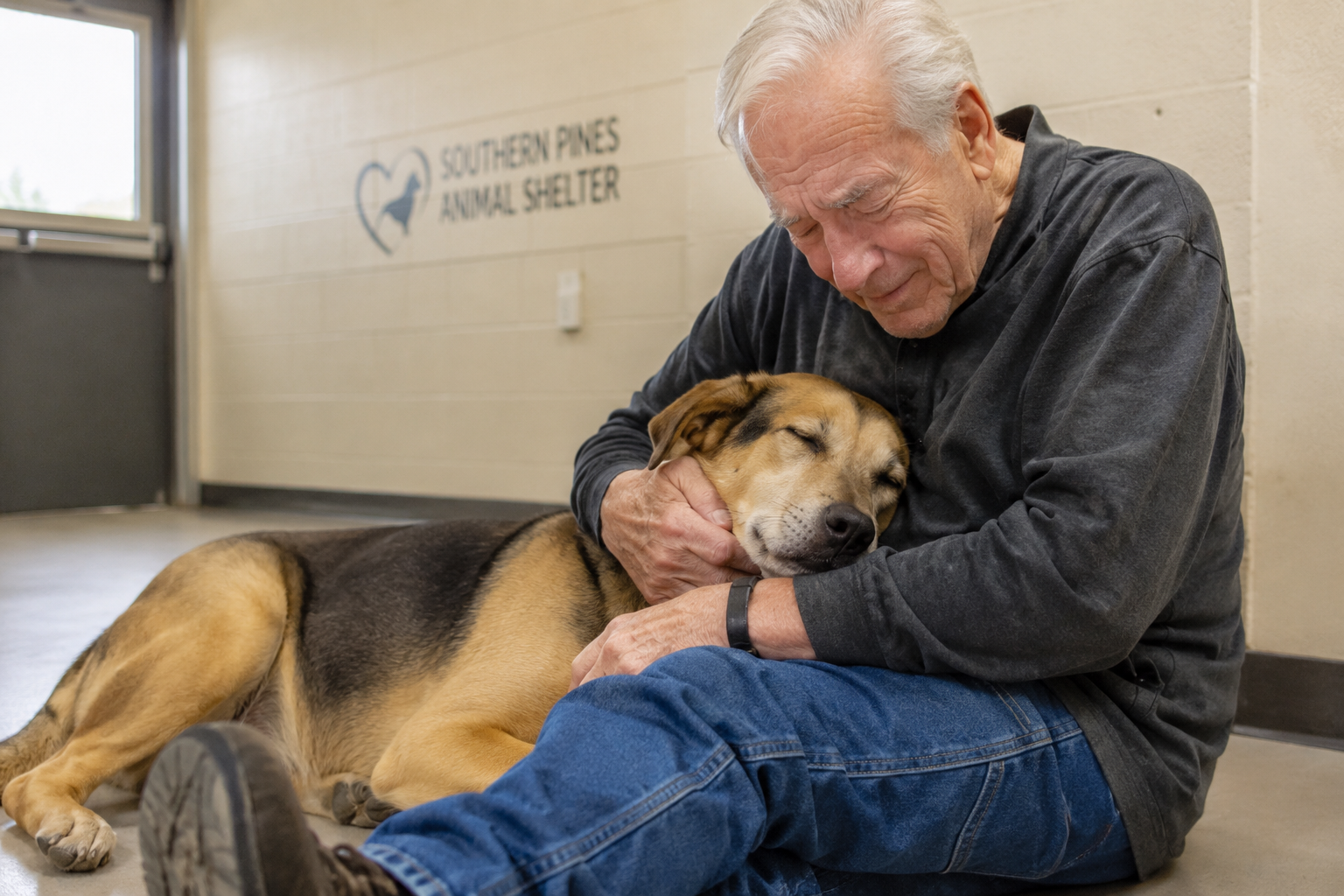
The volunteer unlocked the kennel. Walter did not rush forward. He stood slowly, with the slight stiffness of an older dog, and walked to Harold and sat beside him. Not on his lap. Not demanding anything. Just beside him.
Harold sat down on the kennel floor, which was not easy at seventy-one with his knee the way it was. He sat anyway. Walter rested his chin on Harold’s knee and exhaled — a long, slow breath, like something releasing.
Harold stayed in that kennel for forty-five minutes.
When he came out, he told the volunteer he would take Walter home.
He called his daughter that evening. She answered on the second ring.
“How was it?” she asked.
“I found Eleanor’s dog,” he said.
She was quiet for a moment. “What do you mean?”
“She always said she wanted a calm one. One that just wanted to sit nearby. She said the loud ones made her nervous.” He paused. “He just sits next to me. That’s all he does. Just sits next to me.”
His daughter, who is thirty-eight years old and not prone to crying on the phone, cried on the phone.
Walter has been with Harold for seven months now. They walk the same two-block loop every morning at seven-fifteen because Harold’s knee allows for two blocks and Walter has never once seemed to need more than that. They sit together in the evenings in the chair Harold used to share with Eleanor, Walter’s chin on the armrest, Harold’s hand resting on his back.
The house is still quiet.
But it is a different kind of quiet now. The kind with a heartbeat in it.
Starting Over at Seventy-One
He walked into the shelter at seventy-one, a widower, carrying grief in the particular quiet way that men of his generation often carry it — without a great deal of outward display, without necessarily knowing how to ask for what he needed. He was not looking for a replacement for his wife. He was looking, perhaps without fully articulating it, for something to take care of. Something that needed him back.
The relationship between grief and caregiving is underappreciated. When someone we love dies, we lose not just their presence but the daily routines of tending to them — the small acts of attention that structure a shared life. The morning check-in. The habit of making two cups of coffee. The presence of another living thing in the house that requires something from you. This loss, within the larger loss, is its own particular emptiness.
What a shelter dog offers a grieving person is not a resolution to grief, but something to put their hands on. A reason to wake up at a consistent hour. A creature that needs feeding and walking and presence. Research on pet ownership in older adults consistently finds measurable benefits for mood and sense of purpose. But statistics do not capture the actual transaction that happens when a man at seventy-one looks at a dog and decides they might be good for each other.
He did not replace his wife. He could not. But he added something to his life that had been absent — the quiet hum of being needed, the particular comfort of another creature who is glad, simply and fully, that you are there. That is not nothing. At seventy-one, after loss, it can be everything.
Get Heartwarming Stories in Your Inbox
Join thousands of readers getting uplifting stories every week.